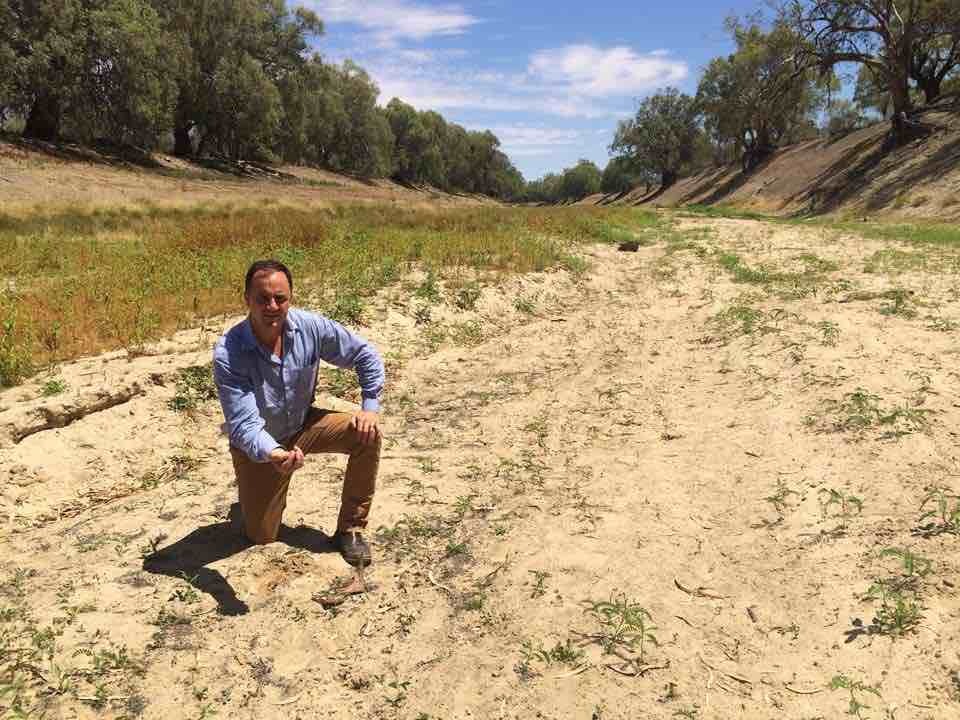
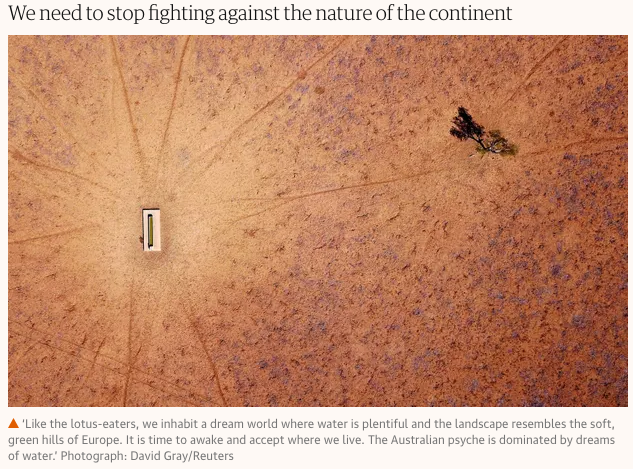
Showing posts with label droughts. Show all posts

9 Ways to assist Australia's farmers with climate change

"Global warming affects agriculture in a number of ways, including through changes in average temperatures, rainfall, and climate extremes (e.g., heat waves); changes in pests and diseases; changes in atmospheric carbon dioxide and ground-level ozone concentrations; changes in the nutritional quality of some foods; and ..."

Climate change and agriculture - Wikipedia


.....................................
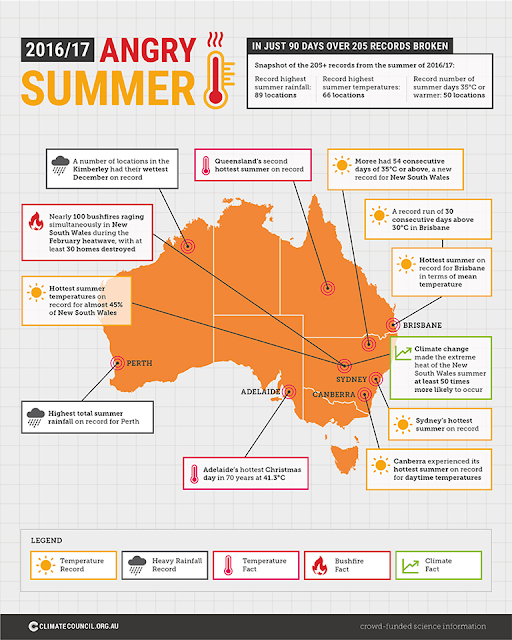

Climaste Council meme
Angry Summer by The Climate Council


It is obvious that many farmers are going to be displaced because of climate change. As their usual crops become unviable and broad scale farming becomes uneconomical because of costs, it is impossible to continue to subsidise farmers that continue to farm or to graze unsuitable animals in an unsustainable fashion. Yet farmers need government support and Australia requires food production.


#jailclimatecriminals, #farmingpractices, #climatecrisis
Australia must learn to manage with less surface water. Artesian water resources must be husbanded.

Suggested Actions

1. “What we still don’t have in the year 2019 is a national (Australian) strategy on climate change in agriculture. There’s still no actual framework to help farmers manage these risks and implement solutions,” she said. Verity Morgan-Schmidt, the chief executive of Farmers for Climate Action

2. Revitalise, with extra funding, our agricultural support services that have provided excellent research and development in the past, new crops and animal husbandry practices can be developed.

3. Provide education for farmers that demonstrate alternative farming practices, for example move from cattle to goats.

4. Only subsidise farmers that change their practice to accommodate a changing climate and protect our soils but retrain farmers unable to accommodate change.

5. Encourage small farming practices such as permaculture, greenhouse production, urban farms.

Note: Intensive farming practices have been shown to be as productive as industrial broad scale farming.

6.  Stop selling water off or subsidising in any way corporations that persist in growing water hungry crops such as cotton and almonds in water scarce areas.

7.  Protect our surface and artesian water from destructive and unsustainable industries.

8.  Support farmers to plan moves from floodplains or cope with more flooding. 


#jailclimatecriminals, #cambioclimatico
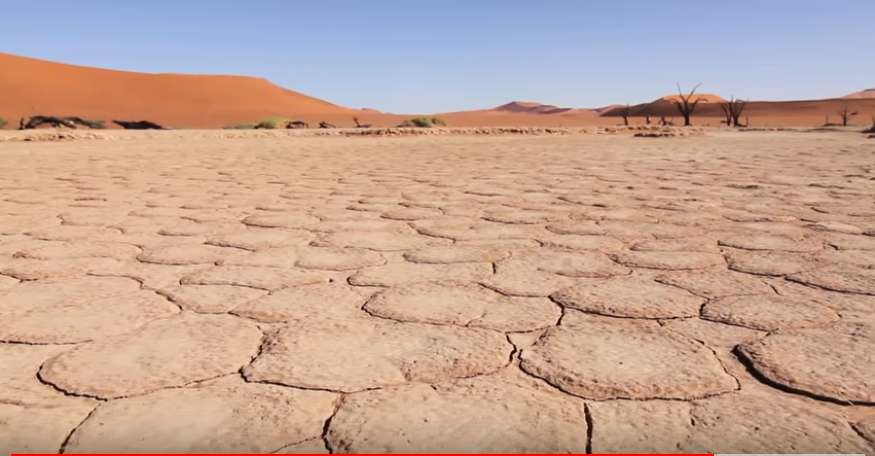
Droughts will occur more often. Soils will erode. Desertification will occur.


9.  Encourage farmers to 'get a yield' with new products.

" 'Agritourism, insect farming off waste resources, bush tucker foods — there are options out there, but it's not traditional agriculture in that sense.'

" 'We need support structures, new ideas, people helping us transition to these other production industries. ' "

She (Anika) believes the first step needs to come from the energy sector to buy more time for other industries to develop response strategies.

'The easiest way to put the brakes on what we are experiencing is to transition away from dirty fossil fuel energy to clean, renewable energy; that then takes the pressure off other industries.' "


An article by Preparations for Climate Change

See also:  Preparing for a Climate Change Health Crisis

Prepare your home for climate change

WARNING: Some of the Australian Government data quoted in 2013 such as the amount of predicted temperature increase and sea level rise appear to be quite conservative estimates that are probably now outdated. Many scientists now predict much higher levels of sea rise. 

For example NASA predicts: Sea Level Will Rise 1-4 feet by 2100


All material below from The Australian Government's site  'Adapting to climate change'  

Adapting to climate change


"Adaptive strategies for building design

Adaptive strategies should be considered for these climate change variables:
  • temperature increase and heatwaves
  • bushfires
  • cyclones and extreme wind
  • severe thunderstorms and high intensity rainfall events
  • flooding
  • sea level rise and storm surge
  • low rainfall."


"A home provides its occupants with a refuge from the climate, but as the climate changes, the home may not be able to meet this need. In general, temperatures are increasing, sea levels are rising and extremes in the weather are more likely. If climate change is considered when a home is being designed or altered, it is likely to remain comfortable for longer, possibly for its whole life.

Although it is important to minimise the extent of climate change through mitigation measures such as reducing greenhouse gas emissions, the opportunity to avoid the impacts of climate change altogether has passed (DCCEE 2010). If we want to ensure that our homes remain ‘as safe as houses’ we need to consider and adapt to the future climate.

In Australia the average life of a brick home is 88 years and a timber home is 58 years (Snow and Prasad 2011); many last much longer than this. Decisions that are made about homes today will therefore continue to have consequences for many decades.


Photo: Karen Disney

Many old homes are loved and used still.

Australia, because of its size, has a range of climates which will vary in their response to climate change. In general there will be:

  • higher temperatures
  • higher annual rainfall in the north, lower rainfall in the south
  • longer periods of drought
  • increased number of days of very high, extreme or catastrophic fire danger
  • increased risk and intensity of severe weather such as tropical cyclones, floods, hailstorms and droughts.


Photo: Robyn McLean
The home was built to withstand the extremes of the Top End tropical climate.

Adequate insurance will help to protect you financially against extreme events. To ensure that it meets needs, you should:

  • know the specific impacts relevant to your region
  • review your current insurance
  • consider seeking professional advice.
You already consider the future when acquiring, building or just living in a home: for example, how livable will it be, will it accommodate a growing family, is it affordable, and is it likely to increase in value. You should also ask what the climate will be like and whether the home will suit these conditions. Take into account your objectives, how long the home is intended to last and any regulatory requirements.
 
Photo: Simon Wood Photography
Fixed awnings have been fitted on west and east facing windows to provide extra shading.


Climate change

Noting that the impacts of climate change will vary from region to region the best estimates are that by 2030 Australia will face:

  • about 1°C of warming, resulting in more heatwaves (CSIRO and BOM 2007; Australian Academy of Science 2010)
  • up to 20% more months of drought (CSIRO and BOM 2007)
  • up to 25% increase in days of very high or extreme fire danger (CSIRO and BOM 2007)
  • increases in storm surges and severe weather events (CSIRO and BOM 2007; Australian Academy of Science 2010)
  • a sea level rise of about 15cm (Australian Academy of Science 2010).
If emissions continue unabated the impacts are likely to be more severe in the future (Australia Academy of Science 2010).
Research the likely climate change impacts for your location and base your decisions upon your findings. There are many sources of information about climate change, including your local council, who may also be able to provide information about planning controls that could guide home design.


Photo: Simon Wood Photography


One central source is www.climatechangeinaustralia.gov.au. For further information about impacts at a state or territory level, see relevant government websites.

Adaptive strategies for building design

Adaptive strategies should be considered for these climate change variables:

  • temperature increase and heatwaves
  • bushfires
  • cyclones and extreme wind
  • severe thunderstorms and high intensity rainfall events
  • flooding
  • sea level rise and storm surge
  • low rainfall.
Many of the options outlined below are from Snow and Prasad (2011). Seek advice from a professional, e.g. an architect or designer, before making changes to the design or redesign of your home.


Bushfires

A significant increase of very high, extreme or catastrophic fire danger days is expected. Minimising fuel loads — things that burn — close to the home will reduce the risk (Gibbons et al. 2012). Keep yard growth trimmed, clear dead wood and rubbish often and use metal rather than wood for fences.

There are several architectural ways to minimise the risk of the home burning and/or maximise the safety of the occupant:

Photo: Rollashi


  • Install shutters and sprinkler systems in high risk zones.
  • Ensure that the roof minimises the risk that burning embers will be caught.
  • Use building materials that are fire resistant.
  •  

Cyclones and extreme wind

Although the total number of cyclones is expected to decrease, high wind events and tropical cyclones of greater intensity may increase; their range could also move further south (CSIRO and BOM 2007).
Extremely strong winds can place a great strain on buildings; any damage to homes can cause subsequent damage to their contents. 

To minimise the risks:

  • use improved fixing systems in the roof structure and the subfloor (increasing the strength in one area may cause another area to fail: consult a professional)
  • design buildings to minimise the wind loads
  • use impact resistant materials for external cladding
  • ensure building materials are largely waterproof and drainage design is effective, particularly for flashing, vents and penetrations.
In an established home, ensure the structural fixing elements have not been compromised by corrosion or previous cyclones (Snow and Prasad 2011).


Severe thunderstorms and high intensity rainfall events

An increase in high intensity rainfall events has been projected but it is difficult to predict whether thunderstorms — hail, wind and tornados — will increase in number and/or intensity. Indications are that hailstorms will increase over the south-east coast of Australia, potentially leading to impact damage and moisture penetration.
Given the significant damage that hailstones can inflict it may be worthwhile preparing homes for the impacts. Options for reducing damage include:

  • selecting roof materials that are impact resistant (e.g. metal rather than terracotta)
  • designing or installing appropriate window protection.


Consider ‘the four Ds’ when managing water flow about the home to reduce damage from high intensity rainfall: deflection (keep it out), drainage (get it out if it gets in), drying (allow wet materials to dry) and durability (select materials that can withstand the effects) (Walford 2001). Options include:

  • designing or installing window protection
  • ensuring roofs are well maintained
  • creating greater capacity to detain and harvest water from a deluge
  • selecting materials that can withstand moisture
  • ensuring there are drainage cavities in walls
  • improving the detailing to roof edges, open decks, walls and joinery, retaining walls, floors, balconies, wall−roof junctions and roofs.
  • ensuring internal and box guttering can withstand a 1-in-100 year rainfall event.


Capturing the extra rain and using it to irrigate green spaces may also offer advantages, such as reducing heat island effects (built-up areas become hotter than nearby rural areas).


Floods


The projected increase in rainfall intensity is likely to result in more flooding events. Flooding can be localised or associated with a river system. Possible impacts include water damage to the home and its contents, the undermining of foundations and the contamination of the home by sewage or mud (Snow and Prasad 2011).
The risk of flooding to homes can be reduced by not building in areas which could flood, i.e. along river floodplains and on low-lying coastal areas. Other options to reduce flooding risk include:

  • exceeding minimum floor levels
  • constructing multistorey homes and using the lower level for non-living areas
  • using water resistant materials (e.g. concrete, fibre cement)
  • ensuring that drainage allows water to escape after the flood
  • raising vulnerable equipment (e.g. service meters)
  • building a limited life dwelling to minimise financial outlay
  • building a levee around the house
  • designing a garden that will safely redirect water.
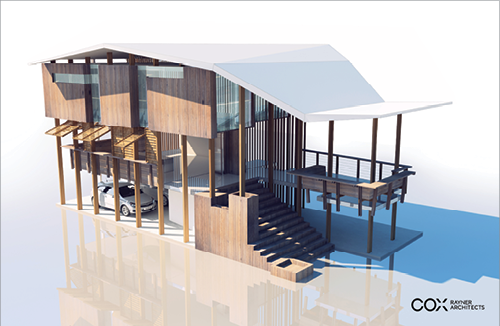
Raising floor level heights may not only reduce the risk of flooding but could also have beneficial effects on passive thermal design (e.g. by increasing subfloor circulation to cool the house). However, using fill to increase the height of the floor may disturb acid sulphate soils so make sure you have a sound knowledge of the site (see Choosing a site).


An architect’s conceptual illustration of a modern home on stilts.

Source: © Cox Rayner Architects
Design of a home that could cope with flood conditions.


Sea level rise and storm surge


Although the coastline of Australia has changed throughout time it has been fairly stable for the last 6,000−7,000 years (DCCEE 2009). More recently, between 1950 and 2000, global sea levels have been rising by an average of 1.8mm per year, a rate that has increased to over 3mm since the mid-1990s (this rate varies significantly around Australia) (CSIRO and BOM 2007). With 85% of the Australian population living in coastal regions, susceptibility to both sea level rise and storm surge is concerning (Snow and Prasad 2011).


Storm surges occur when intense onshore winds push waves harder against the coast, and have the most impact during high tides. Other factors that increase the impact of storms are wind strength and direction and coastal characteristics (CSIRO and BOM 2007).
As a result homes near coastlines and estuaries may thus be more likely to flood and may have to cope with rising watertables. 

Greater foreshore erosion could also expose more homes to the impacts of storm surges and sea level rise (particularly for sandy coasts). Stormwater systems may be less able drain into the sea and therefore may cause flooding further inland (Camilleri 2000).


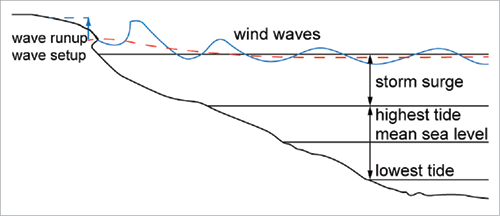
 A line drawing of a cross-section of a beach and the ocean. The lip of the beach is the wave runup and the wave setup. The different heights of seawater are, from top to bottom, wind waves, storm surge, highest tide, mean sea level and lowest tide.
Source: CSIRO and BOM 2007

Characteristics of tide, waves and storm surge combined.

Three strategies can deal with sea level rise and storm surge: protect (e.g. construct sea walls), accommodate (live with the impact) and retreat (DCCEE 2009; Snow and Prasad 2011).

Options for accommodating the risk or retreating include:

  • elevating the home
  • ensuring the parts of the home that may flood can cope (e.g. the foundations)
  • building a limited life home to minimise financial outlay
  • building a transportable home.
For further information about the vulnerability of the coastline of Australia see Climate change risks to Australia’s coast: a first pass national assessment (DCCEE 2009) or consult local government risk assessments.


Low rainfall


In areas where rainfall will decline, droughts will be more severe. Flows into water supply catchments will decrease and evaporation of water and transpiration from trees increase due to higher temperatures (CSIRO and BOM 2007).


Photo: G. Smith


Minimising water use and maximising water efficiency and capture are essential for ensuring there is enough water to maintain lifestyles (see Water).

Author

Author: Department of Climate Change and Energy Efficiency, 2013


Preparing for catastrophic fire seasons

There is no climate sceptic on the end of a fire hose. #jailclimatecriminals
 
Governments must prepare for catastrophic fires.
 
* Establishing services to support those ‘burned out’ and those who cannot insure

* rezoning areas unsuitable for building

* changing building regulations

* employing indigenous people to carry out controlled burning to reduce fuel loads as they have done for thousands of years

* increasing the numbers of professional firefighters, giving more support to volunteer firefighters and purchasing more aviation support are just small steps.

* increasing funding for bushfire research

* the most important action for governments is to cut carbon targets and to pressure other countries to do the same. Tariffs on carbon reckless countries, like the USA, Saudi Arabia, China and Australia are inevitable.


Koalas suffered greatly. #jailclimatecriminals


" The main reason more prescribed burning has not been done is the risk the deliberately lit fires will get out of control and burn down property, or otherwise choke population areas with unhealthy amounts of smoke.

This risk has gone up with the drought, which has meant there are fewer days every year with low-risk fire conditions. It's also gone up with population levels, which has meant more people are affected by prescribed burning.


#climatecrisis, heatwaves  

"With many prescribed burns now conducted close to the expanding urban fringe and close to essential infrastructure and agriculture, the community tolerance levels are very low to heavy smoke and potential damage to delicate ecosystems," Dr Thornton says."

"....  Mr Bradstock described it as a "tired and old conspiracy theory" while Greg Mullins said ex-fire chiefs were annoyed that the fires were being used for political attack."


#bushfire,  #wildfire,  #jailclimatecriminals


"Greg Mullins (former NSW fire and rescue commissioner Greg Mullins) said climate change means it's often too dangerous to burn: "Extreme drought like this, underpinned by 20 years of reduced rainfall, has meant the window for hazard reduction is very narrow now."

He also said a long-term reduction in forestry and national parks personnel has meant hazard reduction has fallen to volunteers.

"We're mainly only available on the weekends," he said.


Climate Council Media Release

How effective is hazard reduction?

Many bushfire experts want to see more hazard reduction, but they also say there's a danger in presenting prescribed burning and fuel management measures as a 'silver bullet solution' to the continent's increasing fire risk.

Some areas are suitable for prescribed burning, while others are not.

"The complexities around hazard reduction burning are large and growing," said Dr Richard Thornton, CEO of the Bushfire and Natural Hazards Cooperative Research Centre."

https://www.abc.net.au/triplej/programs/hack/is-more-prescribed-burning-the-answer-to-bushfire-threat/11844766


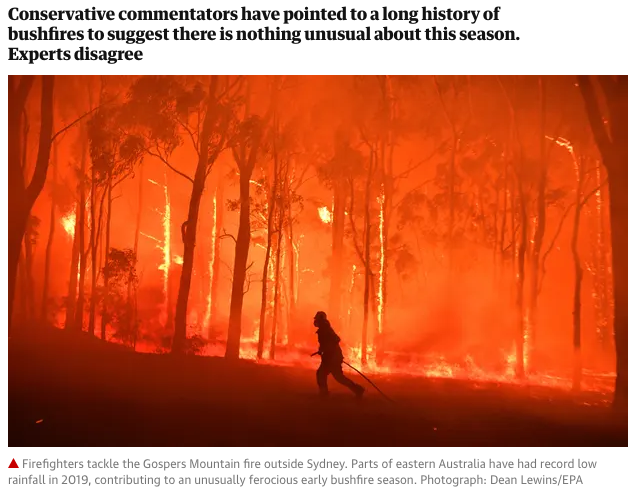
Catastrophic bushfires and catastrophic fire seasons will become a new normal due to the shortening of fuel reduction periods, increasing severe droughts and extreme temperatures.
Governments must prepare for catastrophic fires.
Establishing services...
#wildfire,  #bushfire,  #firefighters,  #climatecrisis

Catastrophic bushfires and catastrophic fire seasons will become a new normal due to the shortening of fuel reduction periods, increasing severe droughts and extreme temperatures. 


See also: Preparing for heatwaves

Your Suggestions:

* Extra water tank on every house plus fire fighter pump diesel. 

* Only fleshy leaf trees near buildings


Prepare for Economic Chaos


"The Climate Council’s report, ‘Compound Costs: How Climate Change is Damaging Australia’s Economy’, finds there are few forces affecting the Australian economy that can match the scale, persistence and systemic risk associated with climate change."

"As the Deputy Governor of the Reserve Bank of Australia noted, the risks that climate change poses to the Australian economy are “ first order” and have knock-on implications for macroeconomic policy (Debelle 2019)."

https://www.climatecouncil.org.au/resources/compound-costs-how-climate-change-damages-australias-economy/


"5. The severe costs of climate change outlined in this report are not inevitable. To avoid the costs of climate change increasing exponentially, greenhouse gas emissions must decline to net zero emissions before 2050. Investments in resilience and adaptation will be essential to reduce or prevent losses in the coming decades.


  • Increasing resilience to extreme weather and climate change should become a key component of urban planning, infrastructure design and building standards.
  • Buildings and infrastructure must be built to withstand future climate hazards and to facilitate the transition to a net zero emissions economy.
  • A credible national climate policy is needed to safeguard our economy by reducing the direct costs of climate change, and avoiding economic risks associated with a sudden, disruptive or disorderly transition to net zero emissions. "      https://www.climatecouncil.org.au/resources/compound-costs-how-climate-change-damages-australias-economy/


"3. The property market is expected to lose $571 billion in value by 2030 due to climate change and extreme weather, and will continue to lose value in the coming decades if emissions remain high.

  • One in every 19 property owners face the prospect of insurance premiums that will be effectively unaffordable by 2030 (costing 1% or more of the property value per year).
  • Some Australians will be acutely and catastrophically affected. Low-lying properties near rivers and coastlines are particularly at risk, with flood risks increasing progressively and coastal inundation risks emerging as a major threat around 2050.
  • Certain events which are likely to become more common because of climate change are not covered by commercial insurance, including coastal inundation and erosion.
  • More than $226 billion in commercial, industrial, road, rail, and residential assets will be at risk from sea level rise alone by 2100, if greenhouse gas emissions continue at high levels. "        https://www.climatecouncil.org.au/resources/compound-costs-how-climate-change-damages-australias-economy

"Extreme events like droughts, heatwaves, cyclones and floods have an impact on agriculture and food production; this is already affecting Australia’s economy and will cost us much more in the future."

https://www.climatecouncil.org.au/resources/compound-costs-how-climate-change-damages-australias-economy


“We will pay for climate breakdown one way or another, so it makes sense to spend the money now to reduce emissions rather than wait until later to pay a lot more for the consequences… It’s a cliché, but it’s true: An ounce of prevention is worth a pound of cure.” 
Nobel Prize-winning economist Joseph Stiglitz, a professor at Columbia University


Related:    Prepare for more severe storms

#jailclimatecriminals   #gaolclimatecriminals   #climatescience   #economy

Your Suggestions:

Reduce consumption on an individual level is a start.


Preparing for climate refugees

It is not just war that creates refugees. South and Central American and African droughts are forcing farmers off their lands. Hurricanes, storms and the resulting flooding is making much of the world’s lower coastal areas unlivable. Sea level rise...
As droughts impact and water becomes scarce wars are fought over resources.


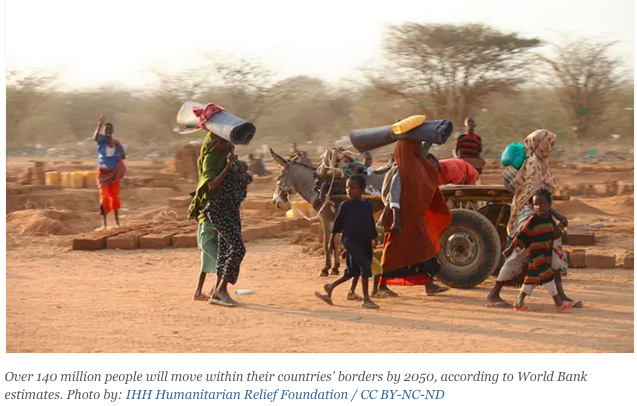
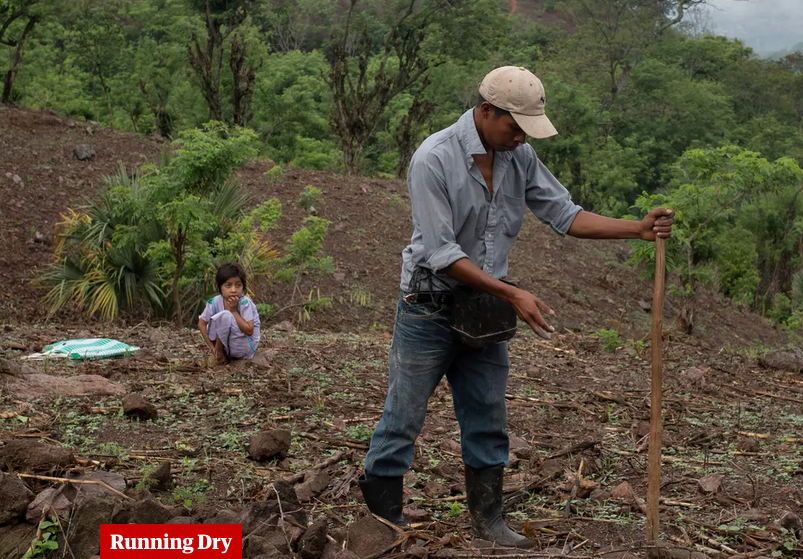
It is not just war that creates refugees. South and Central American and African droughts are forcing farmers off their lands. 

Sea rise destroying Fijian village


Hurricanes, storms and the resulting flooding is making much of the world’s lower coastal  areas unlivable. 


Sea level rise is poisoning or drowning farm lands or swamping island homes. 

You Tube: Climate Change Will Make MILLIONS Homeless. Where Will They Go? 


Heat is forcing indigenous peoples from their traditional lands. 


It is not just war that creates refugees. South and Central American and African droughts are forcing farmers off their lands. Hurricanes, storms and the resulting flooding is making much of the world’s lower coastal areas unlivable. Sea level rise...
Central and South American farmers are forced off their lands by droughts. Many travel north.


It is not just war that creates refugees. South and Central American and African droughts are forcing farmers off their lands. Hurricanes, storms and the resulting flooding is making much of the world’s lower coastal areas unlivable. Sea level rise...

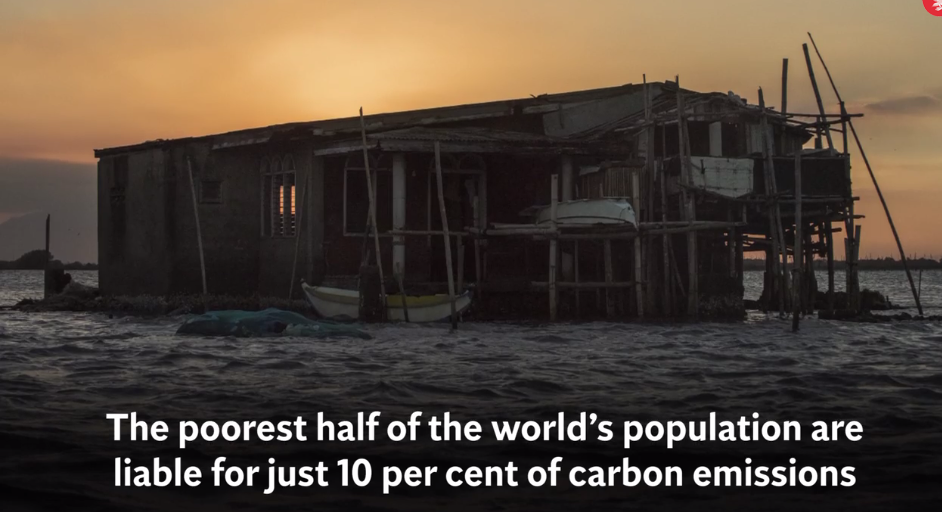
Yet the poorest have hardly contributed to climate change. 

You Tube: Climate Change, Disasters and Refugees - Talking Points


From a purely economic view the indefinite holding of refugees in detention camps is massively expensive. Huge, long-term camps of refugees require a more compassionate response by wealthier nations especially those contributing to wars or climate change.

Governments require a humane and compassionate response to refugees.

The United Nations needs to make 'climate change' a legal reason for refugees to seek asylum.

• Planning how refugees can be assimilated and contribute to less climate affected nations is essential.

Latest News:
Experts say judgment is ‘tipping point’ that opens the door to climate crisis claims for protection

 Wealthy nations must contribute more to the poorer nations so they can better manage their own climate refugees and the effects of climate change. 

Preparing for Water Shortages


Dams will only fill if the rainfall increases but this isn’t predicted in Australia. 


Increased temperatures and greater droughts have already led to immense water shortages with some Australian towns trucking water in an increasing number.
Dams will only fill if the rainfall increases but this isn’t predicted.
Some suggestions for...
Increased temperatures and greater droughts have already led to immense water shortages with some Australian towns trucking water in an increasing number.
Dams will only fill if the rainfall increases but this isn’t predicted.
Some suggestions for...
Increased temperatures and greater droughts have already led to immense water shortages with some Australian towns trucking water in an increasing number.
Dams will only fill if the rainfall increases but this isn’t predicted.
Some suggestions for...
Increased temperatures and greater droughts have already led to immense water shortages with some Australian towns trucking water in an increasing number.
Dams will only fill if the rainfall increases but this isn’t predicted.
Some suggestions for...
Increased temperatures and greater droughts have already led to immense water shortages with some Australian towns trucking water in an increasing number.

Some suggestions for governments are:

• protect the water storage we have from mining pollution and fire damage  

• reuse and recycle water  

• grow alternatives to cotton and other water greedy crops  

• protect our artesian water  

• catch storm water in cities  

• assist rural communities to increase their town water availability  

• support farmers in transitioning to better farm and grazing practices  

• desalinate water using renewable energy  

• facilitate composting toilets   

• protect our water catchment areas from logging, which dries out the forest  

• protect our water catchment areas from any practice which reduces water run off  

• urging mining companies to filter waste water and create wetlands  

• urging irrigators to establish retention ponds of wastewater for reuse 
See also: Preparing for a Climate Change Health Crisis