'When New York Communities for Change helped lead a demonstration of
500 on Monday in Brooklyn to protest George Floyd's killing in
Minneapolis, the grassroots group's activism spoke to a long-standing
link between police violence against African Americans and environmental
justice.
Elizabeth
Yeampierre, executive director of UPROSE, Brooklyn's oldest Latino
community-based organization, said she considers showing up to fight
police brutality and racial violence integral to her climate change
activism.
Bronx Climate Justice North, another grassroots group, says on its website: "Without a focus on correcting injustice, work on climate change addresses only symptoms, and not root causes."
Researchers at Environment and
Climate Change Canada have established an unequivocal correlation
between climate change and the increasing number of extreme rainfall
events in North America—and the data suggests things will get worse if
warming continues.
While the relationship between a
warmer world and a (catastrophically) wetter one has been confirmed at
global and hemispheric levels, the Canadian study is one of the first to
connect the dots at the continental level, reports
CBC. In the study’s first step, the researchers showed that major
downpours did increase at sites around the United States and Canada
between 1961 and 2010. Then, they compared those observations to climate
models that predicted such a trend for a warmer atmosphere.
Christiana Figueres, the architect of the 2015 Paris Agreement, sees the
2020s as a critical moment of opportunity – the ‘golden decade’ – in
the future of our species and our planet.
Earlier this year, the former executive secretary of the United Nations
Framework Convention on Climate Change said: ‘If we do the right thing
this decade, we can continue to design the future but if we don’t, we
are really condemned to a world of increasing destruction, conflict and
pain ... It is a golden ten years in the history of humankind.’
At this live-streamed event, Figueres will be joined by distinguished
Australian climate economist Ross Garnaut.
With his new book,
Superpower, about energy economics in Australia, Garnaut brings a
message of optimism, opportunity and urgency, too.
‘We have unparalleled
renewable energy resources,’ he writes. ‘We also have the necessary
scientific skills.’
After the chaos and failure of the Copenhagen talks in 2009, Figueres
spearheaded a historic agreement of 196 nations at Paris – an
achievement few believed was possible.
Garnaut has been a household name
in Australia since his prescient report on the economics of climate
change to the Commonwealth Parliament in 2008.
Hear these two peerless heavyweights in conversation at the Athenaeum
Theatre, as they discuss reasons for hope and roadmaps for change, with
host Andrew Wear.
"(4) MAKE A DOWN PAYMENT ON A REGENERATIVE ECONOMY, WHILE PREVENTING FUTURE CRISES
While
we urgently need a large, short-term stimulus to protect the health and
economic security of those on the front lines of the COVID-19 crisis,
it is imperative that policymakers also plan for a large, medium-term
stimulus to counteract the economic downturn and ensure a just recovery.
This stimulus should create millions of good, family-sustaining jobs
with high-road labor standards; counter systemic inequities by directing
investments to the working families, communities of color, and
Indigenous communities who face the most economic insecurity; and tackle
the climate crisis that is compounding threats to our economy and
health. All three goals can be achieved simultaneously with public
investments to rebuild our infrastructure, replace lead pipes, expand
wind and solar power, build clean and affordable public transit,
weatherize our buildings, build and repair public housing, manufacture
more clean energy goods, restore our wetlands and forests, expand public
services that support climate resilience, and support regenerative
agriculture led by family farmers. Critically, no stimulus package
should support any corporations whose actions exacerbate climate change -
the response to one existential crisis must not fuel another. Instead,
stimulus money should reward efforts that help advance climate progress."
"We cannot solve the threats of human-induced climate change and loss of
biodiversity in isolation. We either solve both or we solve neither."
"Despite the profound threat of biodiversity loss, it is climate
change that has long been considered the most pressing environmental
concern. That changed this week in Paris, when representatives from 130
nations approved the most comprehensive assessment of global
biodiversity ever undertaken."
Climate change is predicted to be the greatest long-term
threat to biodiversity in many regions and is listed as a key
threatening process in state and Commonwealth legislation.
Projections of future changes in climate in NSW include
increasing temperatures and temperature extremes, increasingly severe
droughts, rising sea levels, possible decreasing rainfall, regional
flooding and reduced water availability in the Murray-Darling Basin.
Australia has experienced cycles of climate change in the past, but
the current changes are more serious due to the rate of change in
atmospheric greenhouse gas levels and temperatures, and because
ecosystems are already stressed by other human impacts.
The most vulnerable ecosystems include coastal ecosystems, alpine
areas, rainforests, fragmented terrestrial ecosystems and areas
vulnerable to fire or low freshwater availability.
Species that could become endangered or extinct include those living
near the upper limit of their temperature range (for example, in alpine
regions); those with restricted climatic niches; and those that cannot
migrate to new habitats due to habitat fragmentation or lack of
alternatives.
Enhancing our understanding of the likely responses of
biodiversity to climate change and re-adjusting management programs
where necessary
Protecting a diverse range of habitats through building a
comprehensive, adequate and representative public reserve system in NSW,
with a focus on under-represented bioregions
Increasing opportunities for species to move across the
landscape by working with partners and the community to protect habitat
and create the necessary connections across landscapes
Assessing adaptation options for ecosystems most at risk from climate change in NSW
The document draws on the NSW Climate Impact Profile which has
assessed the likely impacts of climate change on species and ecosystems
in NSW."
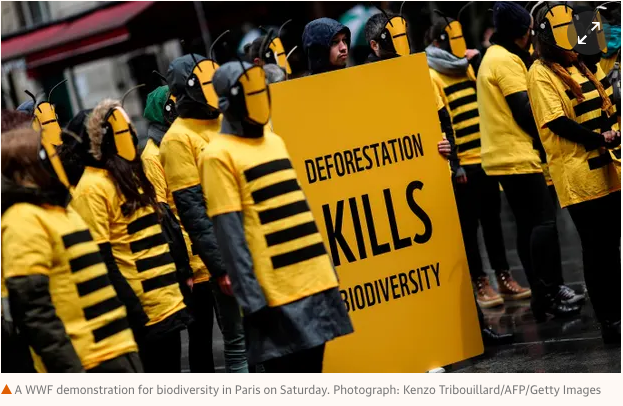
“There is no question we are losing biodiversity at a truly
unsustainable rate that will affect human wellbeing both for current and
future generations,” he said. “We are in trouble if we don’t act, but
there are a range of actions that can be taken to protect nature and
meet human goals for health and development
"The goal is to persuade an audience beyond the usual green NGOs and
government departments. “We need to appeal not just to environment
ministers, but to those in charge of agriculture, transport and energy
because they are the ones responsible for the drivers of biodiversity
loss,” he said.
A focus will be to move away from protection of individual species
and areas, and to look at systemic drivers of change, including
consumption and trade."
"It requires massive changes, from removing subsidies that lead to the
destruction of nature and future warming of the Earth, to enacting laws
that encourage the protection of nature; from reducing our growing
addiction to fossil-fuel energy and natural resource consumption, to
rethinking the definition of a rewarding life."
We need to redirect government subsidies towards more sustainable and regenerative farming.
This will not only contribute towards absorbing carbon and reducing the
emissions of other greenhouse gases, it can also halt a frightening
trajectory where farmland is so overloaded that eventually it just stops growing crops."
Up to 30% of koalas on New South Wales mid-north coast may have been
killed and many more may be endangered in South Australia in the
country’s ongoing bushfire crisis after experts warned fires are the
biggest threat Australian wildlife faces.
"As the Deputy Governor of the Reserve Bank of Australia noted, the
risks that climate change poses to the Australian economy are “ first
order” and have knock-on implications for macroeconomic policy (Debelle
2019)."
"5. The severe costs of climate change outlined in this report are
not inevitable. To avoid the costs of climate change increasing
exponentially, greenhouse gas emissions must decline to net zero
emissions before 2050. Investments in resilience and adaptation will be
essential to reduce or prevent losses in the coming decades.
Increasing resilience to extreme weather and climate change should
become a key component of urban planning, infrastructure design and
building standards.
Buildings and infrastructure must be built to withstand future
climate hazards and to facilitate the transition to a net zero emissions
economy.
"3. The property market is expected to lose $571 billion in value by
2030 due to climate change and extreme weather, and will continue to
lose value in the coming decades if emissions remain high.
One in every 19 property owners face the prospect of insurance
premiums that will be effectively unaffordable by 2030 (costing 1% or
more of the property value per year).
Some Australians will be acutely and catastrophically affected.
Low-lying properties near rivers and coastlines are particularly at
risk, with flood risks increasing progressively and coastal inundation
risks emerging as a major threat around 2050.
Certain events which are likely to become more common because of
climate change are not covered by commercial insurance, including
coastal inundation and erosion.
"Extreme events like droughts, heatwaves, cyclones and floods have
an impact on agriculture and food production; this is already affecting
Australia’s economy and will cost us much more in the future."
“We will pay for climate breakdown one way or another, so it makes
sense to spend the money now to reduce emissions rather than wait until
later to pay a lot more for the consequences… It’s a cliché, but it’s
true: An ounce of prevention is worth a pound of cure.”
Nobel Prize-winning economist Joseph Stiglitz, a professor at Columbia University