Showing posts with label buildings. Show all posts

How To Prepare Your Home For The Effects Of Climate Change: LifeHacker au

How To Prepare Your Home For The Effects Of Climate Change
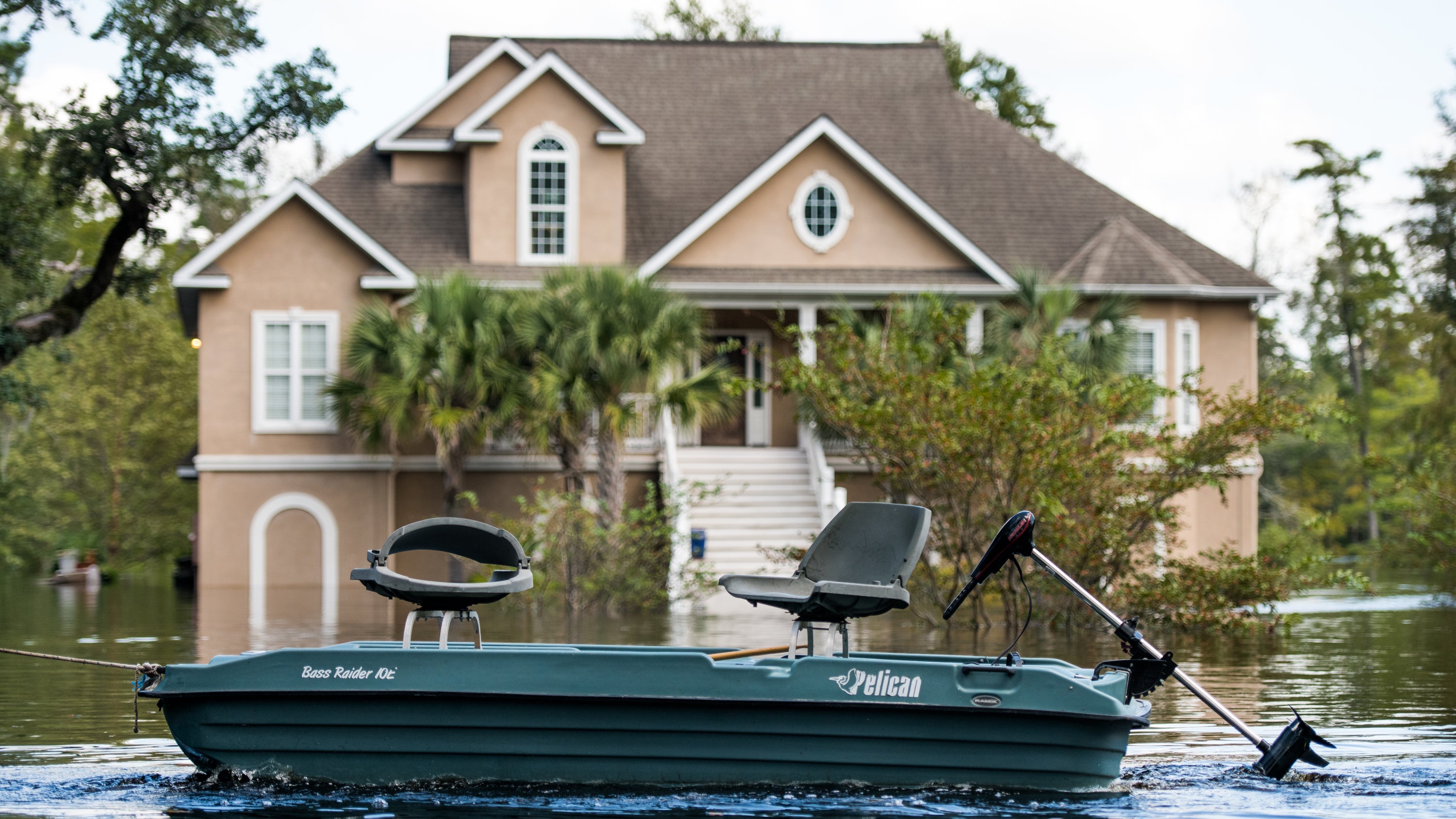
A house in South Carolina after Hurricane Florence. (Photo: Sean Rayford, Getty Images)


Climate change used to seem like something that would confront our grandchildren — a distant concern. Now, though, it’s staring us right in the face when we get up in the morning.
People wade through seawater on sunlit Miami streets; the Florida Panhandle, which rarely sees hurricanes, was recently flattened by a megastorm; and every year bigger and more frequent wildfires burn through Australia and California. 

As our planet warms up, the climate-related changes across the world are well underway. Even if you haven’t had to cope with climate related problems yet, it may not be long before you have to protect your home from extreme weather, fire, flooding, or even sea level rise.

To find out how climate change may affect your area, check out climate risks by region using the Climate Change in Australia Toolkit.

https://www.climatechangeinaustralia.gov.au/en/climate-projections/climate-futures-tool/projections

For example, your flood risk depends not just on your own home and where it sits, but also on things like how the city has channeled nearby creeks and what size culverts your local department of public works has installed beneath your street or road. When it rains harder than ever before, undersized culverts may be overwhelmed and creeks can back up and jump their banks, flooding homes and roads.

In Santa Cruz, California, the city’s climate action manager Tiffany Wise-West, PhD, has posted a detailed action plan, including a Practical Adaptation Actions for Residents. We’re not covering every little thing, she says, but the City’s simple web page is a place for ordinary people to start.
Santa Cruz County is one of the rare places that already has a detailed plan for the future. Ask your city and county government if they have a Local Hazard Mitigation Plan like this one. But even if your area doesn’t, you can rough out a way to address the specific risks your home could face. In general, climate change experts talk about two ways of addressing climate change, preventing it and dealing with the consequences. Here we are focused on dealing with the consequences of climate change, sometimes called climate adaptation.


Sea Level Rise 

Is your seaside beach house at risk of looking like the castle in the bottom of a goldfish bowl? To find out, look up your area on Coast Adapt’s “Climate Change and Sea-Level rising in the Australian Region page.
https://coastadapt.com.au/climate-change-and-sea-level-rise-australian-region
 
Older climate models predict 1 to 4 feet of sea level rise by 2100. But depending on how quickly major ice sheets in Greenland and Antarctica collapse, the sea could rise a dozen meters or more. For now, we don’t know for sure when that might happen.

For example, East Antarctic’s largest ice sheet is threatened by warm sea water slipping underneath it. That could set the front of it afloat and allow the massive landbound part to slide into the sea—enough to raise global sea levels by nearly four meters (12 feet).

Wise-West says the Santa Cruz plan is about the same whether the sea rises a meter in 80 years or sooner. It’s just a matter of moving up the schedule, she says, looking serious.

If you look at Port Arthur, Texas, on the Surging Seas website and set sea level to one meter (3 feet), you can glimpse the future. Here is Port Arthur today:
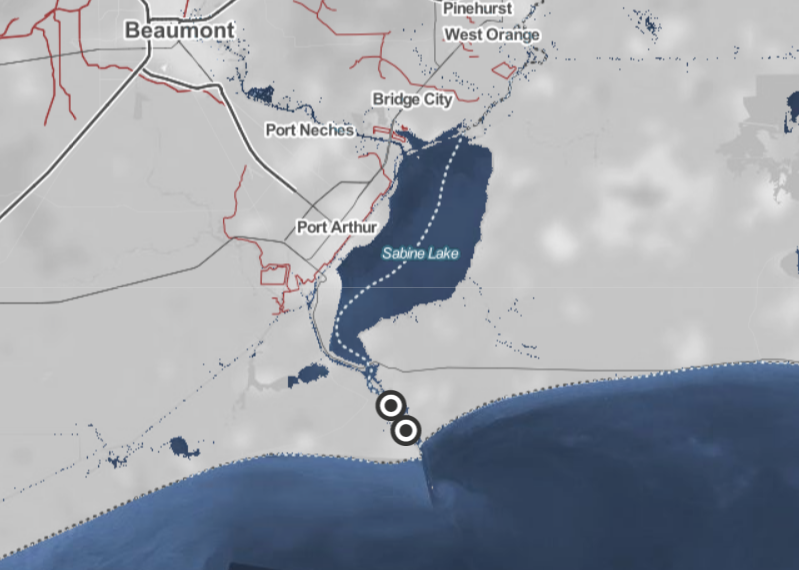
Port Arthur, Texas, today (Screenshot: Surging Seas)
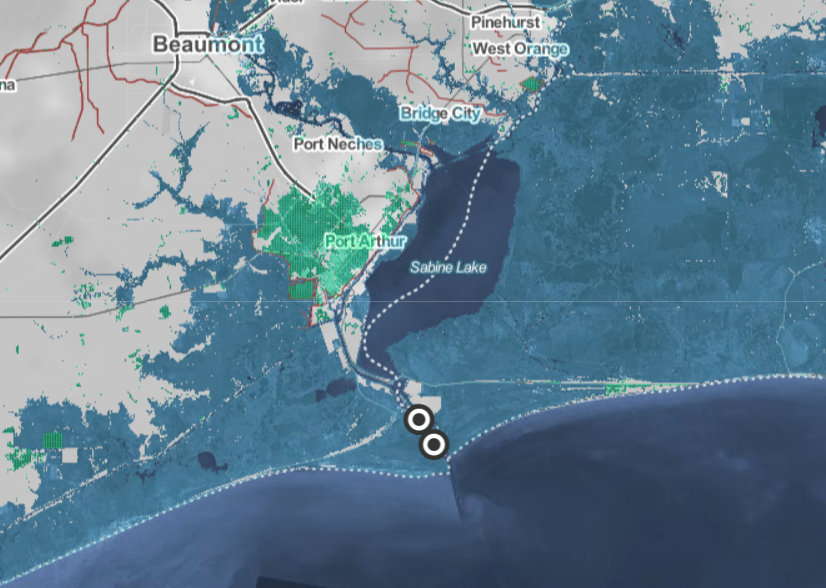
 
Port Arthur is home to 50,000 people and the largest oil refinery in the United States. Here’s what it could look like with one meter of sea level rise:

Port Arthur, Texas, with a meter of sea level rise (Screenshot: Surging Seas)
 
That means that if you lived in Port Arthur, you’d have to think about not only how sea level rise would affect your own backyard, but also how it would affect the oil refinery and how that would affect you.


Extreme Rain

In 2017, Hurricane Harvey slammed Houston with 102cm of rain in four days, flooding 400 square miles. How can you deal with such Biblical flooding? In the short term, evacuate if local authorities say to. Longer term, have an escape plan. But bottom line? Don’t live in a floodplain.
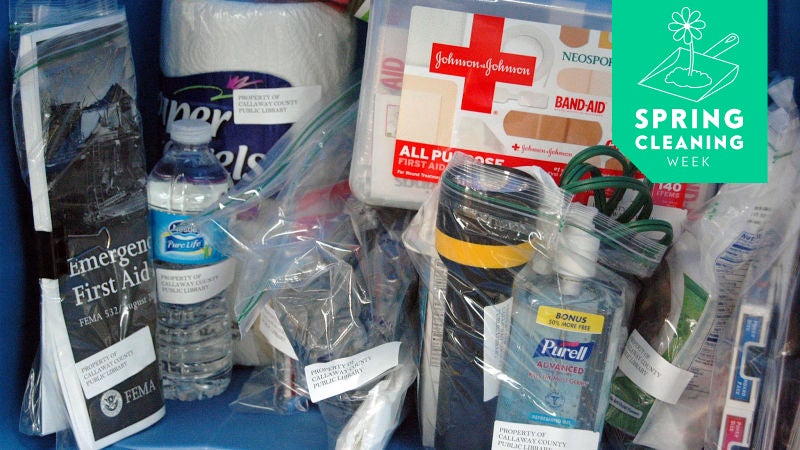
Consolidate Your Home Emergency Kit Now

Remember when you bought a new can opener because you thought you lost your old one? What do you plan on doing with that half-used roll of duct tape that's collecting dust in your garage? The last time you used that flashlight in the kitchen junk drawer was to pretend to be a jedi, wasn't it? These are all items you probably have lying around that you can consolidate into a home emergency kit. It might just save you and your family's lives.


Flooding from rain and overflowing rivers might seem similar to flooding from sea level rise and in some ways a basement full of water is the same whether it’s freshwater or seawater. But there is a difference. Floods eventually recede. Even with climate change, it might be 10 or 50 years before another flood occurs in that location. Sea level rise not only doesn’t recede, it will keep rising for the foreseeable future. If the sea is lapping at your driveway at high tide, it will be at your doorstep in time.

If you are in doubt about whether your home could be affected by sea level rise, it’s not too soon to start thinking about moving inland, whether that’s a just mile to higher ground or to another state.

Hotter Summers

Government maps can help you estimate how much hotter it’ll get where you live.

https://coastadapt.com.au/climate-change-and-sea-level-rise-australian-region

Until you move, here are a few things that will help protect your house from extreme heat:
  • Paint your house white, and use the palest roofing you can find.
  • Plant trees around your house to provide shade.
  • Seal every crack in your roofing.
  • Insulate the roof and walls.
  • Seal all gaps around electrical outlets or pipes coming through the wall.
  • Weather strip your doors and replace leaky windows.
  • Use fans to pull in cooler air in at night.

Extreme Wind

Hurricanes are becoming more powerful and more common. This is because warmer ocean water adds energy to tropical storms as they form. Both kinds of extreme wind destroy buildings by ripping off roofs and hurling heavy objects through the air.
Most building codes were written for relatively mild winds. You can build a house like this one that will withstand a category 5 hurricane. But if that’s not in your budget, make your own house a bit sturdier with wind-resistant roofing, garage doors, and storm shutters. As always, be prepared to evacuate to a safer place when hurricanes are headed for your house."

From LifeHacker.au

Prepare your home for climate change

WARNING: Some of the Australian Government data quoted in 2013 such as the amount of predicted temperature increase and sea level rise appear to be quite conservative estimates that are probably now outdated. Many scientists now predict much higher levels of sea rise. 

For example NASA predicts: Sea Level Will Rise 1-4 feet by 2100


All material below from The Australian Government's site  'Adapting to climate change'  

Adapting to climate change


"Adaptive strategies for building design

Adaptive strategies should be considered for these climate change variables:
  • temperature increase and heatwaves
  • bushfires
  • cyclones and extreme wind
  • severe thunderstorms and high intensity rainfall events
  • flooding
  • sea level rise and storm surge
  • low rainfall."


"A home provides its occupants with a refuge from the climate, but as the climate changes, the home may not be able to meet this need. In general, temperatures are increasing, sea levels are rising and extremes in the weather are more likely. If climate change is considered when a home is being designed or altered, it is likely to remain comfortable for longer, possibly for its whole life.

Although it is important to minimise the extent of climate change through mitigation measures such as reducing greenhouse gas emissions, the opportunity to avoid the impacts of climate change altogether has passed (DCCEE 2010). If we want to ensure that our homes remain ‘as safe as houses’ we need to consider and adapt to the future climate.

In Australia the average life of a brick home is 88 years and a timber home is 58 years (Snow and Prasad 2011); many last much longer than this. Decisions that are made about homes today will therefore continue to have consequences for many decades.


Photo: Karen Disney

Many old homes are loved and used still.

Australia, because of its size, has a range of climates which will vary in their response to climate change. In general there will be:

  • higher temperatures
  • higher annual rainfall in the north, lower rainfall in the south
  • longer periods of drought
  • increased number of days of very high, extreme or catastrophic fire danger
  • increased risk and intensity of severe weather such as tropical cyclones, floods, hailstorms and droughts.


Photo: Robyn McLean
The home was built to withstand the extremes of the Top End tropical climate.

Adequate insurance will help to protect you financially against extreme events. To ensure that it meets needs, you should:

  • know the specific impacts relevant to your region
  • review your current insurance
  • consider seeking professional advice.
You already consider the future when acquiring, building or just living in a home: for example, how livable will it be, will it accommodate a growing family, is it affordable, and is it likely to increase in value. You should also ask what the climate will be like and whether the home will suit these conditions. Take into account your objectives, how long the home is intended to last and any regulatory requirements.
 
Photo: Simon Wood Photography
Fixed awnings have been fitted on west and east facing windows to provide extra shading.


Climate change

Noting that the impacts of climate change will vary from region to region the best estimates are that by 2030 Australia will face:

  • about 1°C of warming, resulting in more heatwaves (CSIRO and BOM 2007; Australian Academy of Science 2010)
  • up to 20% more months of drought (CSIRO and BOM 2007)
  • up to 25% increase in days of very high or extreme fire danger (CSIRO and BOM 2007)
  • increases in storm surges and severe weather events (CSIRO and BOM 2007; Australian Academy of Science 2010)
  • a sea level rise of about 15cm (Australian Academy of Science 2010).
If emissions continue unabated the impacts are likely to be more severe in the future (Australia Academy of Science 2010).
Research the likely climate change impacts for your location and base your decisions upon your findings. There are many sources of information about climate change, including your local council, who may also be able to provide information about planning controls that could guide home design.


Photo: Simon Wood Photography


One central source is www.climatechangeinaustralia.gov.au. For further information about impacts at a state or territory level, see relevant government websites.

Adaptive strategies for building design

Adaptive strategies should be considered for these climate change variables:

  • temperature increase and heatwaves
  • bushfires
  • cyclones and extreme wind
  • severe thunderstorms and high intensity rainfall events
  • flooding
  • sea level rise and storm surge
  • low rainfall.
Many of the options outlined below are from Snow and Prasad (2011). Seek advice from a professional, e.g. an architect or designer, before making changes to the design or redesign of your home.


Bushfires

A significant increase of very high, extreme or catastrophic fire danger days is expected. Minimising fuel loads — things that burn — close to the home will reduce the risk (Gibbons et al. 2012). Keep yard growth trimmed, clear dead wood and rubbish often and use metal rather than wood for fences.

There are several architectural ways to minimise the risk of the home burning and/or maximise the safety of the occupant:

Photo: Rollashi


  • Install shutters and sprinkler systems in high risk zones.
  • Ensure that the roof minimises the risk that burning embers will be caught.
  • Use building materials that are fire resistant.
  •  

Cyclones and extreme wind

Although the total number of cyclones is expected to decrease, high wind events and tropical cyclones of greater intensity may increase; their range could also move further south (CSIRO and BOM 2007).
Extremely strong winds can place a great strain on buildings; any damage to homes can cause subsequent damage to their contents. 

To minimise the risks:

  • use improved fixing systems in the roof structure and the subfloor (increasing the strength in one area may cause another area to fail: consult a professional)
  • design buildings to minimise the wind loads
  • use impact resistant materials for external cladding
  • ensure building materials are largely waterproof and drainage design is effective, particularly for flashing, vents and penetrations.
In an established home, ensure the structural fixing elements have not been compromised by corrosion or previous cyclones (Snow and Prasad 2011).


Severe thunderstorms and high intensity rainfall events

An increase in high intensity rainfall events has been projected but it is difficult to predict whether thunderstorms — hail, wind and tornados — will increase in number and/or intensity. Indications are that hailstorms will increase over the south-east coast of Australia, potentially leading to impact damage and moisture penetration.
Given the significant damage that hailstones can inflict it may be worthwhile preparing homes for the impacts. Options for reducing damage include:

  • selecting roof materials that are impact resistant (e.g. metal rather than terracotta)
  • designing or installing appropriate window protection.


Consider ‘the four Ds’ when managing water flow about the home to reduce damage from high intensity rainfall: deflection (keep it out), drainage (get it out if it gets in), drying (allow wet materials to dry) and durability (select materials that can withstand the effects) (Walford 2001). Options include:

  • designing or installing window protection
  • ensuring roofs are well maintained
  • creating greater capacity to detain and harvest water from a deluge
  • selecting materials that can withstand moisture
  • ensuring there are drainage cavities in walls
  • improving the detailing to roof edges, open decks, walls and joinery, retaining walls, floors, balconies, wall−roof junctions and roofs.
  • ensuring internal and box guttering can withstand a 1-in-100 year rainfall event.


Capturing the extra rain and using it to irrigate green spaces may also offer advantages, such as reducing heat island effects (built-up areas become hotter than nearby rural areas).


Floods


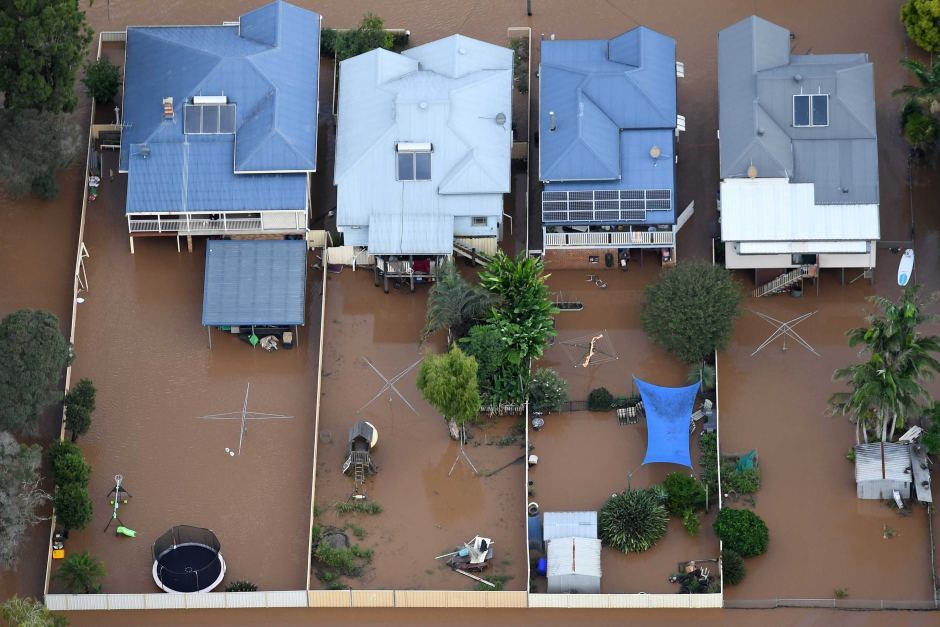
The projected increase in rainfall intensity is likely to result in more flooding events. Flooding can be localised or associated with a river system. Possible impacts include water damage to the home and its contents, the undermining of foundations and the contamination of the home by sewage or mud (Snow and Prasad 2011).
The risk of flooding to homes can be reduced by not building in areas which could flood, i.e. along river floodplains and on low-lying coastal areas. Other options to reduce flooding risk include:

  • exceeding minimum floor levels
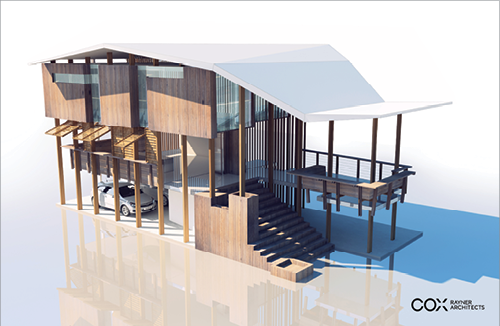
  • constructing multistorey homes and using the lower level for non-living areas
  • using water resistant materials (e.g. concrete, fibre cement)
  • ensuring that drainage allows water to escape after the flood
  • raising vulnerable equipment (e.g. service meters)
  • building a limited life dwelling to minimise financial outlay
  • building a levee around the house
  • designing a garden that will safely redirect water.
Raising floor level heights may not only reduce the risk of flooding but could also have beneficial effects on passive thermal design (e.g. by increasing subfloor circulation to cool the house). However, using fill to increase the height of the floor may disturb acid sulphate soils so make sure you have a sound knowledge of the site (see Choosing a site).


An architect’s conceptual illustration of a modern home on stilts.

Source: © Cox Rayner Architects
Design of a home that could cope with flood conditions.


Sea level rise and storm surge


Although the coastline of Australia has changed throughout time it has been fairly stable for the last 6,000−7,000 years (DCCEE 2009). More recently, between 1950 and 2000, global sea levels have been rising by an average of 1.8mm per year, a rate that has increased to over 3mm since the mid-1990s (this rate varies significantly around Australia) (CSIRO and BOM 2007). With 85% of the Australian population living in coastal regions, susceptibility to both sea level rise and storm surge is concerning (Snow and Prasad 2011).


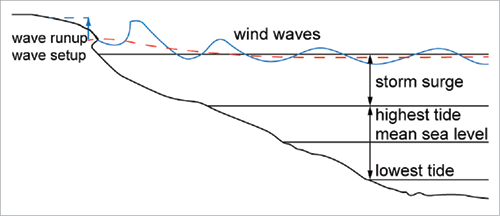
Storm surges occur when intense onshore winds push waves harder against the coast, and have the most impact during high tides. Other factors that increase the impact of storms are wind strength and direction and coastal characteristics (CSIRO and BOM 2007).
As a result homes near coastlines and estuaries may thus be more likely to flood and may have to cope with rising watertables. 

Greater foreshore erosion could also expose more homes to the impacts of storm surges and sea level rise (particularly for sandy coasts). Stormwater systems may be less able drain into the sea and therefore may cause flooding further inland (Camilleri 2000).


 A line drawing of a cross-section of a beach and the ocean. The lip of the beach is the wave runup and the wave setup. The different heights of seawater are, from top to bottom, wind waves, storm surge, highest tide, mean sea level and lowest tide.
Source: CSIRO and BOM 2007

Characteristics of tide, waves and storm surge combined.

Three strategies can deal with sea level rise and storm surge: protect (e.g. construct sea walls), accommodate (live with the impact) and retreat (DCCEE 2009; Snow and Prasad 2011).

Options for accommodating the risk or retreating include:

  • elevating the home
  • ensuring the parts of the home that may flood can cope (e.g. the foundations)
  • building a limited life home to minimise financial outlay
  • building a transportable home.
For further information about the vulnerability of the coastline of Australia see Climate change risks to Australia’s coast: a first pass national assessment (DCCEE 2009) or consult local government risk assessments.


Low rainfall


In areas where rainfall will decline, droughts will be more severe. Flows into water supply catchments will decrease and evaporation of water and transpiration from trees increase due to higher temperatures (CSIRO and BOM 2007).


Photo: G. Smith


Minimising water use and maximising water efficiency and capture are essential for ensuring there is enough water to maintain lifestyles (see Water).

Author

Author: Department of Climate Change and Energy Efficiency, 2013


Prepare for more severe storms


"Although scientists are uncertain whether climate change will lead to an increase in the number of hurricanes, warmer ocean temperatures and higher sea levels are expected to intensify their impacts."
 https://www.c2es.org/content/hurricanes-and-climate-change/


Queensland: Cyclone Debbie caused massive damage to crops.


How can we prepare for more severe storms? 


"How to Build Resilience

Reducing greenhouse gas emissions is one way to reduce the risk of the strongest storms in the future. Communities can also bolster their resilience to the impacts of hurricanes by:
  • Preserving coastal wetlands, dunes, and reefs to absorb storm surges.
  • Replenishing beaches and improve infrastructure that affords coastal protection, such as seawalls.
  • Elevating vulnerable buildings to reduce flood damage.
  • Designing structures to be resilient to high winds and flying debris.
  • Enacting policies that discourage development in vulnerable areas.
  • Preparing prior to a storm’s arrival by boarding windows, clearing property of potential flying debris, and having an evacuation plan."    https://www.c2es.org/content/hurricanes-and-climate-change/


Suggestions: 

• strengthen regulations to prevent further development and new infrastructure on susceptible coastlines

• ensure emergency services are well prepared and supported financially

• support people in developing emergency plans


• ensure the vulnerable can access support

• financially support smaller nations unable to prepare sufficiently for storms


Preparing for more severe floods


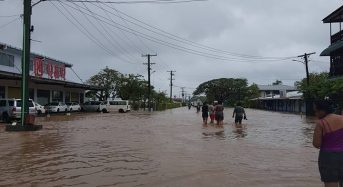
So many parts of the world are vulnerable to coastal flooding. Hurricanes and rain events are now more severe partly because the ocean is warmer and evaporation from the sea is increased.
Suggested actions for governments are:
• preventing the...
So many parts of the world are vulnerable to coastal flooding. Hurricanes and rain events are now more severe partly because the ocean is warmer and evaporation from the sea is increased.
Suggested actions for governments are:
• preventing the...So many parts of the world are vulnerable to coastal flooding. Hurricanes and rain events are now more severe partly because the ocean is warmer and evaporation from the sea is increased.
Suggested actions for governments are:
• preventing the...
So many parts of the world are vulnerable to coastal flooding. Hurricanes and rain events are now more severe partly because the ocean is warmer and evaporation from the sea is increased.
Suggested actions for governments are:
• preventing the...
So many parts of the world are vulnerable to coastal flooding. Hurricanes and rain events are now more severe partly because the ocean is warmer and evaporation from the sea is increased.
Suggested actions for governments are:
• preventing the...
So many parts of the world are vulnerable to coastal flooding. Hurricanes and rain events are now more severe partly because the ocean is warmer and evaporation from the sea is increased.

Suggested actions for governments are:

• preventing the erection of any building or services on floodplains  • creating flood retention structures  • better funding emergency services  • reducing polluting carbon emissions  • establishing flood shelters for people and animals  • establishing a service for the rescue of animals and people  • farmer education and research programs which take account of more frequent floods

See also: Preparing for heatwaves

Preparing for heatwaves


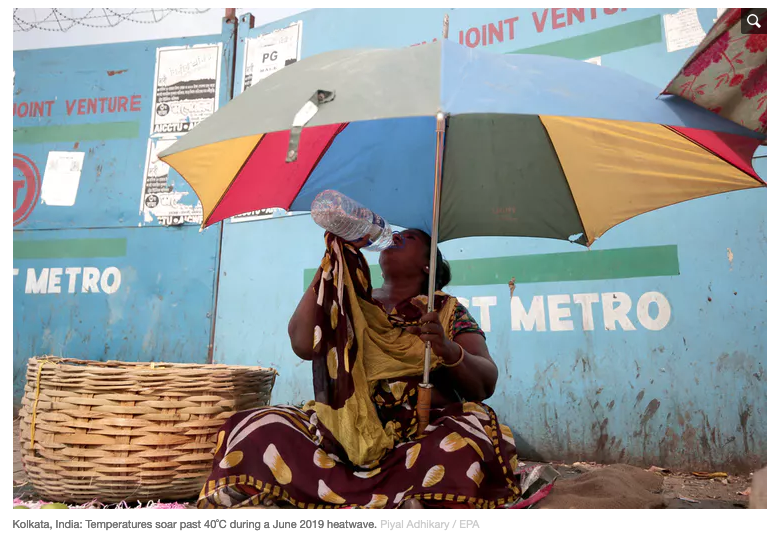
Heatwaves are already a major killer around the world.
Here are just some suggested preparations:
•tougher insulation requirements in buildings •cool retreat areas for those unable to remain cool in a home •modification of worker safety protections...
Heatwaves are already a major killer around the world.
Here are just some suggested preparations:
•tougher insulation requirements in buildings •cool retreat areas for those unable to remain cool in a home •modification of worker safety protections...
Heatwaves are already a major killer around the world.
Here are just some suggested preparations:
•tougher insulation requirements in buildings •cool retreat areas for those unable to remain cool in a home •modification of worker safety protections...
Heatwaves are already a major killer around the world.

Here are just some suggested preparations:

• tougher insulation requirements in buildings 

• cool retreat areas for those unable to remain cool in a home

• modification of worker safety protections
 
• modified building regulations

• air conditioned public transport and public buildings 

• increasing health budget

• increasing public health education 

• preparation for the compassionate processing of climate refugees

• reviewing the predicted effect of extreme temperatures on transport   and service facilities 

• back up power supplies and resources for hugely increased airconditioning demands

Deaths per decade from heatwaves