WARNING: Some of the Australian Government data quoted in 2013 such as the amount of predicted temperature increase and sea level rise appear to be quite conservative estimates that are probably now outdated. Many scientists now predict much higher levels of sea rise.
For example NASA predicts: Sea Level Will Rise 1-4 feet by 2100


"A home provides its occupants with a refuge from the climate, but as the climate changes, the home may not be able to meet this need. In general, temperatures are increasing, sea levels are rising and extremes in the weather are more likely. If climate change is considered when a home is being designed or altered, it is likely to remain comfortable for longer, possibly for its whole life.
Although it is important to minimise the extent of climate change through mitigation measures such as reducing greenhouse gas emissions, the opportunity to avoid the impacts of climate change altogether has passed (DCCEE 2010). If we want to ensure that our homes remain ‘as safe as houses’ we need to consider and adapt to the future climate.
In Australia the average life of a brick home is 88 years and a timber home is 58 years (Snow and Prasad 2011); many last much longer than this. Decisions that are made about homes today will therefore continue to have consequences for many decades.
Australia, because of its size, has a range of climates which will
vary in their response to climate change. In general there will be:

Adequate insurance will help to protect you financially against extreme events. To ensure that it meets needs, you should:
Research the likely climate change impacts for your location and base your decisions upon your findings. There are many sources of information about climate change, including your local council, who may also be able to provide information about planning controls that could guide home design.
One central source is www.climatechangeinaustralia.gov.au. For further information about impacts at a state or territory level, see relevant government websites.
There are several architectural ways to minimise the risk of the home burning and/or maximise the safety of the occupant:
Extremely strong winds can place a great strain on buildings; any damage to homes can cause subsequent damage to their contents.
To minimise the risks:
Given the significant damage that hailstones can inflict it may be worthwhile preparing homes for the impacts. Options for reducing damage include:

Consider ‘the four Ds’ when managing water flow about the home to reduce damage from high intensity rainfall: deflection (keep it out), drainage (get it out if it gets in), drying (allow wet materials to dry) and durability (select materials that can withstand the effects) (Walford 2001). Options include:
Capturing the extra rain and using it to irrigate green spaces may also offer advantages, such as reducing heat island effects (built-up areas become hotter than nearby rural areas).
The projected increase in rainfall intensity is likely to result in
more flooding events. Flooding can be localised or associated with a
river system. Possible impacts include water damage to the home and its
contents, the undermining of foundations and the contamination of the
home by sewage or mud (Snow and Prasad 2011).
The risk of flooding to homes can be reduced by not building in areas which could flood, i.e. along river floodplains and on low-lying coastal areas. Other options to reduce flooding risk include:
Storm surges occur when intense onshore winds push waves harder against the coast, and have the most impact during high tides. Other factors that increase the impact of storms are wind strength and direction and coastal characteristics (CSIRO and BOM 2007).
As a result homes near coastlines and estuaries may thus be more likely to flood and may have to cope with rising watertables.
Greater foreshore erosion could also expose more homes to the impacts of storm surges and sea level rise (particularly for sandy coasts). Stormwater systems may be less able drain into the sea and therefore may cause flooding further inland (Camilleri 2000).
Three strategies can deal with sea level rise and storm surge: protect (e.g. construct sea walls), accommodate (live with the impact) and retreat (DCCEE 2009; Snow and Prasad 2011).
Options for accommodating the risk or retreating include:
Minimising water use and maximising water efficiency and capture are essential for ensuring there is enough water to maintain lifestyles (see Water).
For example NASA predicts: Sea Level Will Rise 1-4 feet by 2100

All material below from The Australian Government's site 'Adapting to climate change'
Adapting to climate change
"Adaptive strategies for building design
Adaptive strategies should be considered for these climate change variables:
- temperature increase and heatwaves
- bushfires
- cyclones and extreme wind
- severe thunderstorms and high intensity rainfall events
- flooding
- sea level rise and storm surge
- low rainfall."

"A home provides its occupants with a refuge from the climate, but as the climate changes, the home may not be able to meet this need. In general, temperatures are increasing, sea levels are rising and extremes in the weather are more likely. If climate change is considered when a home is being designed or altered, it is likely to remain comfortable for longer, possibly for its whole life.
Although it is important to minimise the extent of climate change through mitigation measures such as reducing greenhouse gas emissions, the opportunity to avoid the impacts of climate change altogether has passed (DCCEE 2010). If we want to ensure that our homes remain ‘as safe as houses’ we need to consider and adapt to the future climate.
In Australia the average life of a brick home is 88 years and a timber home is 58 years (Snow and Prasad 2011); many last much longer than this. Decisions that are made about homes today will therefore continue to have consequences for many decades.
 |
| Photo: Karen Disney |
Many old homes are loved and used still.
- higher temperatures
- higher annual rainfall in the north, lower rainfall in the south
- longer periods of drought
- increased number of days of very high, extreme or catastrophic fire danger
- increased risk and intensity of severe weather such as tropical cyclones, floods, hailstorms and droughts.

Photo: Robyn McLean
The home was built to withstand the extremes of the Top End tropical climate.
Adequate insurance will help to protect you financially against extreme events. To ensure that it meets needs, you should:
- know the specific impacts relevant to your region
- review your current insurance
- consider seeking professional advice.
 |
| Photo: Simon Wood Photography Fixed awnings have been fitted on west and east facing windows to provide extra shading. |
Climate change
Noting that the impacts of climate change will vary from region to region the best estimates are that by 2030 Australia will face:- about 1°C of warming, resulting in more heatwaves (CSIRO and BOM 2007; Australian Academy of Science 2010)
- up to 20% more months of drought (CSIRO and BOM 2007)
- up to 25% increase in days of very high or extreme fire danger (CSIRO and BOM 2007)
- increases in storm surges and severe weather events (CSIRO and BOM 2007; Australian Academy of Science 2010)
- a sea level rise of about 15cm (Australian Academy of Science 2010).
Research the likely climate change impacts for your location and base your decisions upon your findings. There are many sources of information about climate change, including your local council, who may also be able to provide information about planning controls that could guide home design.
 |
| Photo: Simon Wood Photography |
One central source is www.climatechangeinaustralia.gov.au. For further information about impacts at a state or territory level, see relevant government websites.
Adaptive strategies for building design
Adaptive strategies should be considered for these climate change variables:- temperature increase and heatwaves
- bushfires
- cyclones and extreme wind
- severe thunderstorms and high intensity rainfall events
- flooding
- sea level rise and storm surge
- low rainfall.
Bushfires
A significant increase of very high, extreme or catastrophic fire danger days is expected. Minimising fuel loads — things that burn — close to the home will reduce the risk (Gibbons et al. 2012). Keep yard growth trimmed, clear dead wood and rubbish often and use metal rather than wood for fences.There are several architectural ways to minimise the risk of the home burning and/or maximise the safety of the occupant:
 |
| Photo: Rollashi |
- Install shutters and sprinkler systems in high risk zones.
- Ensure that the roof minimises the risk that burning embers will be caught.
- Use building materials that are fire resistant.
Cyclones and extreme wind
Although the total number of cyclones is expected to decrease, high wind events and tropical cyclones of greater intensity may increase; their range could also move further south (CSIRO and BOM 2007).Extremely strong winds can place a great strain on buildings; any damage to homes can cause subsequent damage to their contents.
To minimise the risks:
- use improved fixing systems in the roof structure and the subfloor (increasing the strength in one area may cause another area to fail: consult a professional)
- design buildings to minimise the wind loads
- use impact resistant materials for external cladding
- ensure building materials are largely waterproof and drainage design is effective, particularly for flashing, vents and penetrations.
Severe thunderstorms and high intensity rainfall events
An increase in high intensity rainfall events has been projected but it is difficult to predict whether thunderstorms — hail, wind and tornados — will increase in number and/or intensity. Indications are that hailstorms will increase over the south-east coast of Australia, potentially leading to impact damage and moisture penetration.Given the significant damage that hailstones can inflict it may be worthwhile preparing homes for the impacts. Options for reducing damage include:
- selecting roof materials that are impact resistant (e.g. metal rather than terracotta)
- designing or installing appropriate window protection.

Consider ‘the four Ds’ when managing water flow about the home to reduce damage from high intensity rainfall: deflection (keep it out), drainage (get it out if it gets in), drying (allow wet materials to dry) and durability (select materials that can withstand the effects) (Walford 2001). Options include:
- designing or installing window protection
- ensuring roofs are well maintained
- creating greater capacity to detain and harvest water from a deluge
- selecting materials that can withstand moisture
- ensuring there are drainage cavities in walls
- improving the detailing to roof edges, open decks, walls and joinery, retaining walls, floors, balconies, wall−roof junctions and roofs.
- ensuring internal and box guttering can withstand a 1-in-100 year rainfall event.
Capturing the extra rain and using it to irrigate green spaces may also offer advantages, such as reducing heat island effects (built-up areas become hotter than nearby rural areas).
Floods

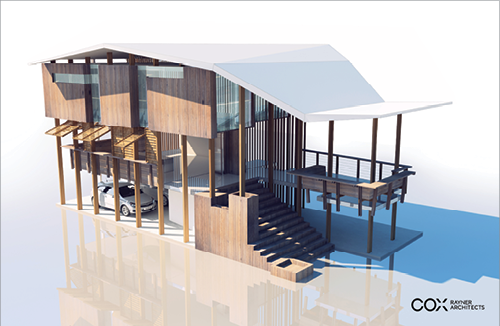
The risk of flooding to homes can be reduced by not building in areas which could flood, i.e. along river floodplains and on low-lying coastal areas. Other options to reduce flooding risk include:
- exceeding minimum floor levels
- constructing multistorey homes and using the lower level for non-living areas
- using water resistant materials (e.g. concrete, fibre cement)
- ensuring that drainage allows water to escape after the flood
- raising vulnerable equipment (e.g. service meters)
- building a limited life dwelling to minimise financial outlay
- building a levee around the house
- designing a garden that will safely redirect water.
Source: © Cox Rayner Architects
Design of a home that could cope with flood conditions.
Sea level rise and storm surge
Although the coastline of Australia has changed throughout time it has been fairly stable for the last 6,000−7,000 years (DCCEE 2009). More recently, between 1950 and 2000, global sea levels have been rising by an average of 1.8mm per year, a rate that has increased to over 3mm since the mid-1990s (this rate varies significantly around Australia) (CSIRO and BOM 2007). With 85% of the Australian population living in coastal regions, susceptibility to both sea level rise and storm surge is concerning (Snow and Prasad 2011).
Storm surges occur when intense onshore winds push waves harder against the coast, and have the most impact during high tides. Other factors that increase the impact of storms are wind strength and direction and coastal characteristics (CSIRO and BOM 2007).
As a result homes near coastlines and estuaries may thus be more likely to flood and may have to cope with rising watertables.
Greater foreshore erosion could also expose more homes to the impacts of storm surges and sea level rise (particularly for sandy coasts). Stormwater systems may be less able drain into the sea and therefore may cause flooding further inland (Camilleri 2000).
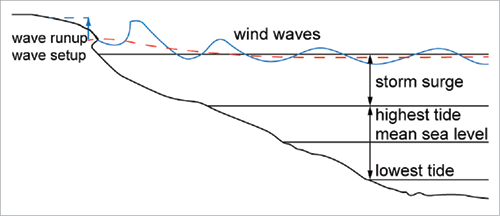 |
| Source: CSIRO and BOM 2007 |
Characteristics of tide, waves and storm surge combined.
Three strategies can deal with sea level rise and storm surge: protect (e.g. construct sea walls), accommodate (live with the impact) and retreat (DCCEE 2009; Snow and Prasad 2011).
Options for accommodating the risk or retreating include:
- elevating the home
- ensuring the parts of the home that may flood can cope (e.g. the foundations)
- building a limited life home to minimise financial outlay
- building a transportable home.
Low rainfall
In areas where rainfall will decline, droughts will be more severe. Flows into water supply catchments will decrease and evaporation of water and transpiration from trees increase due to higher temperatures (CSIRO and BOM 2007).
 |
| Photo: G. Smith |
Minimising water use and maximising water efficiency and capture are essential for ensuring there is enough water to maintain lifestyles (see Water).


