Showing posts with label #climateaction. Show all posts

New reflective coating will keep homes of the future cooler: The Guardian

Tests show coating can reduce solar heating by up to 20% – and it doesn’t just come in white


Santorini, Greece
Santerini, Greece
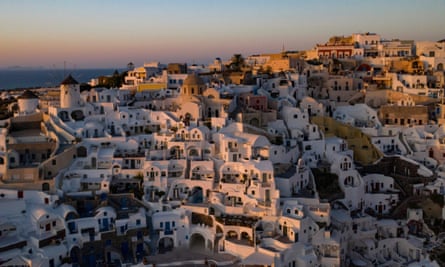
Painting homes white, as residents have done in Santorini, Greece, can help keep the interior cool.

Photograph: Aris Messinis/AFP/Getty


As the dazzling buildings on the Greek island of Santorini demonstrate, painting your home white helps to keep it cool. Wearing white clothes is also a good way of beating the heat on hot days.

But it isn’t easy to keep white clothes clean, and some of us like a bit more colour in our lives. Thankfully, a new ultra-reflective coating will offer a kaleidoscope of cooling colours to choose from.

Yuan Yang, a materials scientist at Columbia University in New York City, and colleagues have developed a specialised paint coating made from two layers. The bottom layer is made using a porous polymer that scatters and reflects infrared light; the upper layer is a commercial coloured paint.

Testing carried out on a sunny summer’s day showed the black version of the two-layer paint kept an object 15.6C (28.8F) cooler than standard black paint. If applied to a building the scientists estimate their coating could reduce solar heating on a wall by 10-20%.

The research, reported in the Science Advances journal, suggests the new coating is adaptable and could be used to paint buildings, cars and even textiles, giving the residents of Santorini the option of a colour change.

Read The Guardian Story

Published on Tue 23 Jun 2020

Is your local government body climate change ready?

Three local government areas in or near Melbourne, Australia,
have encouraged their residents to be climate change ready by planning for:


• wildfire

• flood

• storms

• heat waves


• sea rise

• coastal inundation

• drought


Visit climateready.com.au for ideas and planning information.

Your local government may have similar information. If not, you can ask why not.

As Protests Rage Over George Floyd’s Death, Climate Activists Embrace Racial Justice: Insideclimatenews

climate change is real
#climatejustice
'When New York Communities for Change helped lead a demonstration of 500 on Monday in Brooklyn to protest George Floyd's killing in Minneapolis, the grassroots group's activism spoke to a long-standing link between police violence against African Americans and environmental justice.


Elizabeth Yeampierre, executive director of UPROSE, Brooklyn's oldest Latino community-based organization, said she considers showing up to fight police brutality and racial violence integral to her climate change activism. 

Bronx Climate Justice North, another grassroots group, says on its website: "Without a focus on correcting injustice, work on climate change addresses only symptoms, and not root causes."

2.0°C Would Shift Once-in-a-Century Storms to Once in Five Years, Canadian Study Concludes: The Energy Mix

Ryan L. C. Quan/wikimedia commons
Flooding - Climate Change
Researchers at Environment and Climate Change Canada have established an unequivocal correlation between climate change and the increasing number of extreme rainfall events in North America—and the data suggests things will get worse if warming continues. 


While the relationship between a warmer world and a (catastrophically) wetter one has been confirmed at global and hemispheric levels, the Canadian study is one of the first to connect the dots at the continental level, reports CBC. In the study’s first step, the researchers showed that major downpours did increase at sites around the United States and Canada between 1961 and 2010. Then, they compared those observations to climate models that predicted such a trend for a warmer atmosphere. 

'How can I prepare my children for climate change?' : Yale Climate Connections

"Four types of skills will be essential in a warming world.


Dear Sara,

How can I prepare my children for their future on a hot planet? They are both under two, so I know I’m looking a little far ahead. However, I think it’s better to teach them the tools and skills they’ll need now, rather than to wait until they are forced to adapt in a hurry. And I don’t mean things like teaching them to avoid meat and dairy, buy used or repurposed items, and consume less “stuff” in general. I am talking about things like: Is it a good idea for them to know how to garden and can, so that if there are food shortages, they will have produce?

– Christina in Michigan

Dear Christina,
Let’s acknowledge the scary stuff up front.

Serious and widespread consequences of climate change are likely to occur during your children’s lifetimes. Such consequences include a die-off of most of the world’s coral reefs, risks to economic growth, and food shortages—particularly in countries near the equator. That’s according to a landmark 2018 scientific report that examined the impacts of warming the world by 1.5°C (2.7°F) above pre-industrial temperatures. Absent a rapid reduction in heat-trapping gases, the world is likely to cross the 1.5°C threshold roughly around 2040, when your children will be in their twenties.
(The key phrase here is “absent a rapid reduction in heat-trapping gases.” I’ll return to that in a bit.)

How on earth can you prepare your children for such a world? Consider these four broad categories of skills and knowledge:

1. The basic facts

Your kids are still far too young for deep conversations about the heating of our planet. But as both a moral and a practical matter, they’ll eventually need to know that climate change is occurring and that it’s likely to affect them.

To prep for talking with your kids, you might start by brushing up on the topic yourself. One resource is NASA’s excellent climate website for children. Frankly, it’s a useful primer for adults, too.

Meanwhile, pick up one or two children’s books on the topic. Here’s one list of titles on the market.
As your kids grow old enough to start asking questions about climate change (or hearing about it from other children), consider metering out information in small, age-appropriate doses. Here’s how science journalist Michelle Nijhuis talks about the topic with her 10-year-old daughter: “As a parent, I approach the subject of climate change much like I approach the subject of sex: While I answer all questions, without hesitation and in full, I make sure not to answer more questions than I’m asked.”

If you do nothing else on this list, educating your children about climate change will help them to make wise choices as adults. They’ll know the risks of buying ocean-front property, for example.

2. Practical skills

There’s a long list of skills that might prove useful if disasters interrupt the normal flow of goods and services. Brief interruptions – like when floodwaters from Hurricane Florence blocked access to Wilmington, North Carolina, in 2018 – require knowing how to prepare for and survive a few days on your own with flashlights, canned foods, and other emergency supplies. If longer interruptions occur, your kids might want to know how to garden, preserve food, safely gather and filter water, make repairs to a damaged home, sew clothing, provide medical care, install or fix solar arrays, use self-defense techniques, and more.

The list can quickly become overwhelming, so I’d let your children’s interests guide the skills they learn. Your kids love “helping” in the kitchen? Great, they can learn how to preserve produce. Or your children are constantly “operating” on dolls? They get signed up for a first-aid class.

Also, try prioritizing skills related to the projected climate impacts in your region. U.S. residents can learn what’s expected in their areas by consulting the National Climate Assessment, which includes chapters for each region. The Midwest, for example, is likely to experience more heat waves, poor air quality days, and intense rainfall in the future.

Each projected impact can be paired with one or more skills. For instance, because heatwaves will likely become more common in the Midwest, teach your children how to prevent heat stroke. You might also explain how to stay safe in flash-flooding conditions, since intense precipitation is becoming more common. And because you can expect worsening air quality, you can show them how to monitor outdoor air conditions.

Realistically, your kids won’t have the time or aptitude to master every skill they might need. That’s OK. Teach them as best you can and trust that they will live in a community among other skilled people. Which brings us to …

3. Healthy interpersonal and emotional skills

People who are part of strong, well-functioning communities are better able to withstand trauma, according to an American Psychological Association report. “Nearly every study of resilience emphasizes the importance of strengthening the social networks within communities and encouraging communities to create patterns of working together to overcome adversity, whether physical or psychological,” the report’s authors write.

In other words, teaching your children how to play well with others will help prepare them for hard times, whether they arise from climate change or other causes.
For more on the interpersonal and emotional skills to cultivate in your children – and how to go about teaching them – take a look at this guide from the Australian Psychological Society, “Raising children to thrive in a climate changed world.

A sampling of the advice offered in the guide: “Help your children to build and maintain healthy relationships with their friends and other community members by (e)ncouraging your children to ‘work it out’ if they are having a problem with a friend or a group, rather than just quitting.”
The beauty of teaching your children these skills is that they’ll benefit substantially from them in any case. No matter what the future brings, your kids will be well-served by knowing how to be a good friend.

4. How to be an engaged citizen

To the extent that you’re able to, vote, write letters to the editor, contact your political leaders, and participate in community groups that are organizing others to do the same.

Doing so will serve two purposes. One, you’ll model for your children how to build stronger communities. By taking them along to town hall meetings, you’ll show them how to work with others to overcome problems.

Also, remember the phrase “absent a rapid reduction in heat-trapping gases”? There is still a window of time – albeit a rapidly closing one – to blunt the worst consequences of climate change. The most effective thing that parents can do to prepare for the future is to ensure that civic leaders are safeguarding it.

-Sara
Wondering how climate change could affect you or your loved ones? Send your questions to sara@yaleclimateconnections.org. Questions may be edited for length and clarity."

Tuesday, April 23, 2019
 

How To Prepare Your Home For The Effects Of Climate Change: LifeHacker au

How To Prepare Your Home For The Effects Of Climate Change

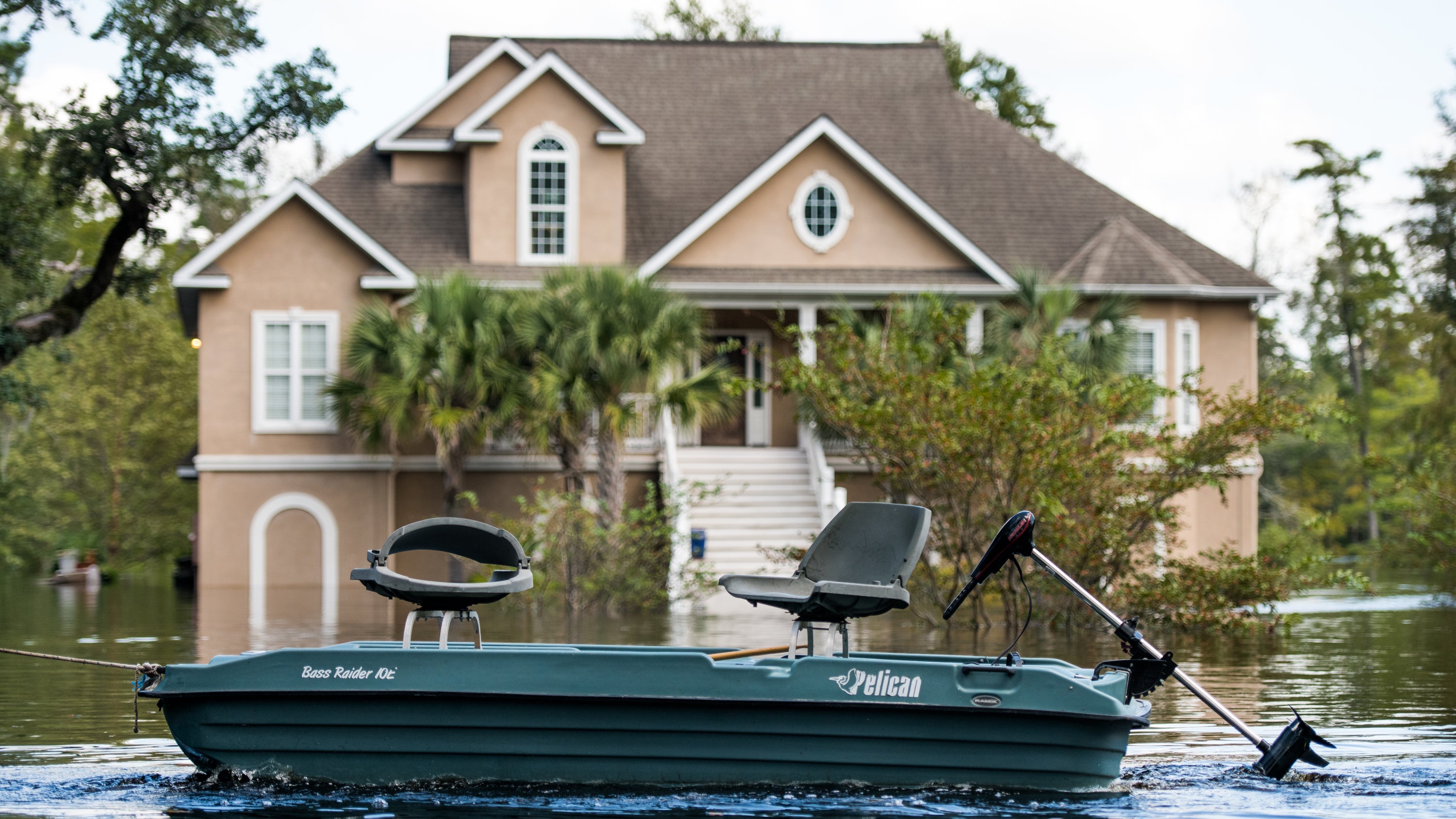
A house in South Carolina after Hurricane Florence. (Photo: Sean Rayford, Getty Images)


Climate change used to seem like something that would confront our grandchildren — a distant concern. Now, though, it’s staring us right in the face when we get up in the morning.
People wade through seawater on sunlit Miami streets; the Florida Panhandle, which rarely sees hurricanes, was recently flattened by a megastorm; and every year bigger and more frequent wildfires burn through Australia and California. 

As our planet warms up, the climate-related changes across the world are well underway. Even if you haven’t had to cope with climate related problems yet, it may not be long before you have to protect your home from extreme weather, fire, flooding, or even sea level rise.

To find out how climate change may affect your area, check out climate risks by region using the Climate Change in Australia Toolkit.

https://www.climatechangeinaustralia.gov.au/en/climate-projections/climate-futures-tool/projections

For example, your flood risk depends not just on your own home and where it sits, but also on things like how the city has channeled nearby creeks and what size culverts your local department of public works has installed beneath your street or road. When it rains harder than ever before, undersized culverts may be overwhelmed and creeks can back up and jump their banks, flooding homes and roads.

In Santa Cruz, California, the city’s climate action manager Tiffany Wise-West, PhD, has posted a detailed action plan, including a Practical Adaptation Actions for Residents. We’re not covering every little thing, she says, but the City’s simple web page is a place for ordinary people to start.
Santa Cruz County is one of the rare places that already has a detailed plan for the future. Ask your city and county government if they have a Local Hazard Mitigation Plan like this one. But even if your area doesn’t, you can rough out a way to address the specific risks your home could face. In general, climate change experts talk about two ways of addressing climate change, preventing it and dealing with the consequences. Here we are focused on dealing with the consequences of climate change, sometimes called climate adaptation.


Sea Level Rise 

Is your seaside beach house at risk of looking like the castle in the bottom of a goldfish bowl? To find out, look up your area on Coast Adapt’s “Climate Change and Sea-Level rising in the Australian Region page.
https://coastadapt.com.au/climate-change-and-sea-level-rise-australian-region
 
Older climate models predict 1 to 4 feet of sea level rise by 2100. But depending on how quickly major ice sheets in Greenland and Antarctica collapse, the sea could rise a dozen meters or more. For now, we don’t know for sure when that might happen.

For example, East Antarctic’s largest ice sheet is threatened by warm sea water slipping underneath it. That could set the front of it afloat and allow the massive landbound part to slide into the sea—enough to raise global sea levels by nearly four meters (12 feet).

Wise-West says the Santa Cruz plan is about the same whether the sea rises a meter in 80 years or sooner. It’s just a matter of moving up the schedule, she says, looking serious.

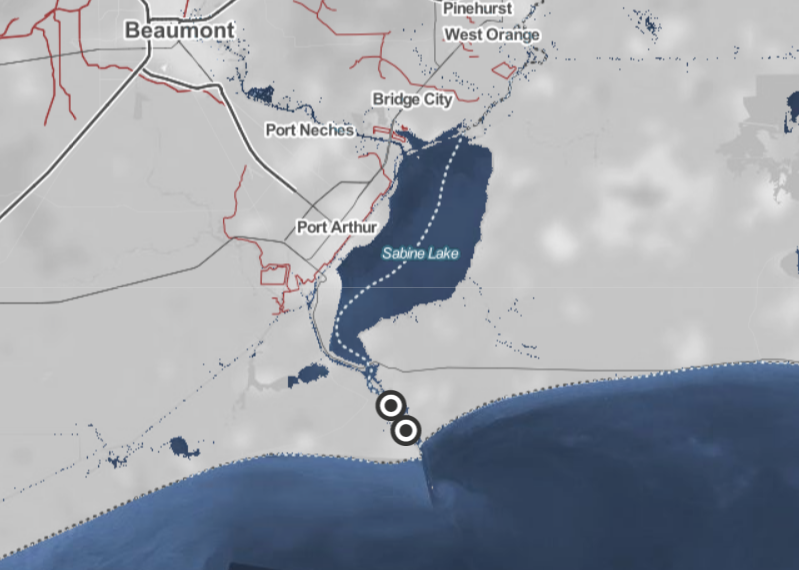
If you look at Port Arthur, Texas, on the Surging Seas website and set sea level to one meter (3 feet), you can glimpse the future. Here is Port Arthur today:

Port Arthur, Texas, today (Screenshot: Surging Seas)

 
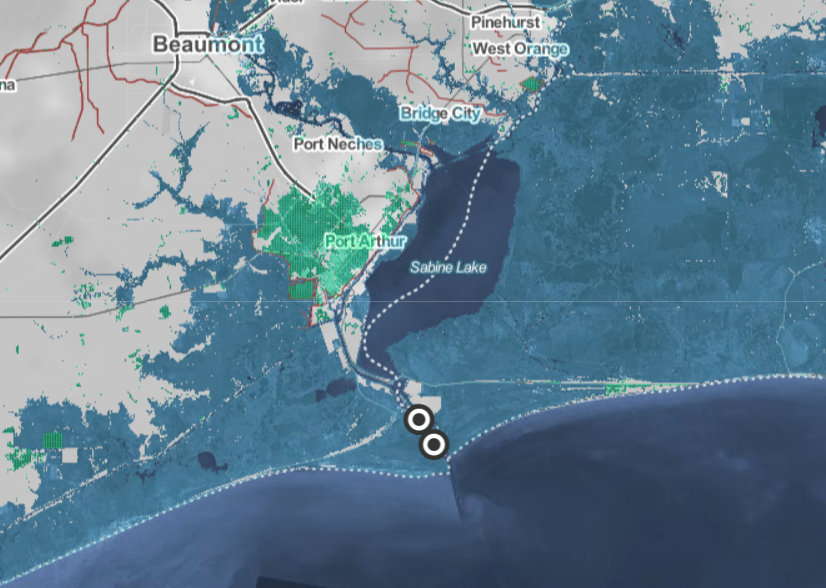
Port Arthur is home to 50,000 people and the largest oil refinery in the United States. Here’s what it could look like with one meter of sea level rise:

Port Arthur, Texas, with a meter of sea level rise (Screenshot: Surging Seas)
 
That means that if you lived in Port Arthur, you’d have to think about not only how sea level rise would affect your own backyard, but also how it would affect the oil refinery and how that would affect you.


Extreme Rain

In 2017, Hurricane Harvey slammed Houston with 102cm of rain in four days, flooding 400 square miles. How can you deal with such Biblical flooding? In the short term, evacuate if local authorities say to. Longer term, have an escape plan. But bottom line? Don’t live in a floodplain.

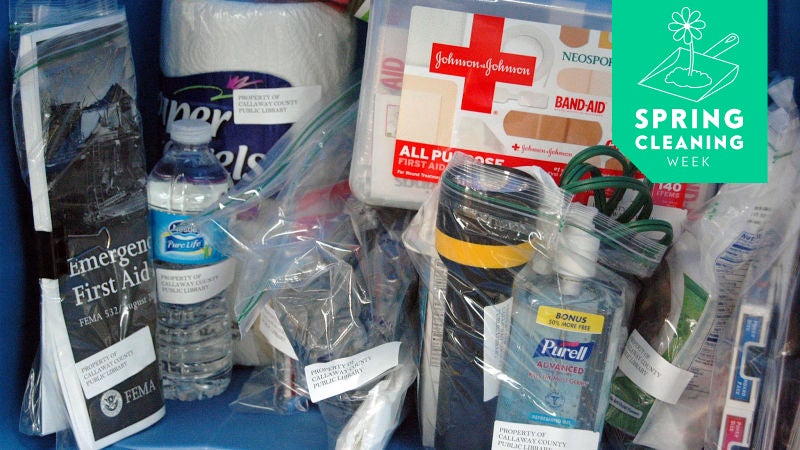
Consolidate Your Home Emergency Kit Now

Remember when you bought a new can opener because you thought you lost your old one? What do you plan on doing with that half-used roll of duct tape that's collecting dust in your garage? The last time you used that flashlight in the kitchen junk drawer was to pretend to be a jedi, wasn't it? These are all items you probably have lying around that you can consolidate into a home emergency kit. It might just save you and your family's lives.


Flooding from rain and overflowing rivers might seem similar to flooding from sea level rise and in some ways a basement full of water is the same whether it’s freshwater or seawater. But there is a difference. Floods eventually recede. Even with climate change, it might be 10 or 50 years before another flood occurs in that location. Sea level rise not only doesn’t recede, it will keep rising for the foreseeable future. If the sea is lapping at your driveway at high tide, it will be at your doorstep in time.

If you are in doubt about whether your home could be affected by sea level rise, it’s not too soon to start thinking about moving inland, whether that’s a just mile to higher ground or to another state.

Hotter Summers

Government maps can help you estimate how much hotter it’ll get where you live.

https://coastadapt.com.au/climate-change-and-sea-level-rise-australian-region

Until you move, here are a few things that will help protect your house from extreme heat:
  • Paint your house white, and use the palest roofing you can find.
  • Plant trees around your house to provide shade.
  • Seal every crack in your roofing.
  • Insulate the roof and walls.
  • Seal all gaps around electrical outlets or pipes coming through the wall.
  • Weather strip your doors and replace leaky windows.
  • Use fans to pull in cooler air in at night.

Extreme Wind

Hurricanes are becoming more powerful and more common. This is because warmer ocean water adds energy to tropical storms as they form. Both kinds of extreme wind destroy buildings by ripping off roofs and hurling heavy objects through the air.
Most building codes were written for relatively mild winds. You can build a house like this one that will withstand a category 5 hurricane. But if that’s not in your budget, make your own house a bit sturdier with wind-resistant roofing, garage doors, and storm shutters. As always, be prepared to evacuate to a safer place when hurricanes are headed for your house."

From LifeHacker.au

How to prepare for climate change: Bradford Council


Here we have one local government area preparing its residents for climate change.

"What is climate change adaptation?

Even if we slow down climate change by reducing our carbon emissions we will still see some impact in the Bradford District. Adaptation is how we adjust to the different climate and the process of preparing for extreme weather.

The main weather events likely to impact on the Bradford district are:
  • floods 
  • droughts 
  • heat waves 
  • severe winds 
  • severe snowfall

Are you ready for climate change?

We need to prepare for the impacts of climate change, to reduce the risks to you, your property and the District.
The weather in Bradford is changing. The summers will become warmer and drier and the winters wetter and milder. Adapting to climate change must become a part of our life. We must adapt our property, communities and lifestyles for more extremes of weather.
Be prepared and take action - climate change is happening
We can all take simple steps to make sure we are ready for the extremes in weather:

Adapt your home and property

Flooding

You don’t have to live near a river for your property to flood, in Bradford surface water flooding is a big issue this is when rain cannot enter the drainage system so flows over the surface, this can affect property even at the top of a hill.
  • flood proof your property
  • keep valuables, precious items and documents on higher ground
  • make sure you have insurance cover for your property and contents
  • avoid tarmac or paving over the garden, as this prevents rain draining away
More advice on flood proofing your home is available from the Environment Agency. Further information can also be found on our flooding pages.

Heatwaves and drought

Temperatures are likely to rise and we are likely to have more heat waves. The hot temperatures can affect our health, particularly young and elderly people. It may also affect the availability of water.
  • install blinds at the windows
  • create an area of shade in your garden where you can sit to cool off
Try to conserve water:
  • install a water butt, it's a good idea to connect it to a drainpipe. The rainwater collected can be used to water plants and wash the car
  • reuse bath water to water plants
  • use mulch on the garden, a protective layer on the soil prevents moisture loss, you can also use pebbles, gravel, chipped bark, grass clippings
  • take shorter showers, you could even fit a low flow shower head
  • don't let water run while washing your face - brush your teeth while waiting for the hot water then fill a basin to wash or shave
  • operate dishwashers and clothes washers only when they are fully loaded, or properly set the water level for the size of load you are using
  • stop drips - a dripping tap can waste more than 60 litres a week, thousands in a year. Turn off all your taps fully and fix leaky taps around the home
Better to act now – otherwise the impacts can be both costly and timely

Prepare yourself for extreme weather

Be aware of the impact the weather may have on you, people you know and the community.
Things to consider:
  • in a heat wave wear sun screen and a hat and drink plenty of water
  • snowfall and icy weather can make people more prone to falls so take care
  • weather can affect transport networks, making it difficult to get around
  • services may be disrupted in times of extreme weather, winds can bring down power lines and water pipes may freeze during cold periods
  • be aware of vulnerable members of your community they may need extra help
  • be aware of the needs of any elderly or sick relatives
  • have a list of emergency contacts and numbers
  • be prepared for an emergency have a plan and an emergency kit bag
It is important to identify
  1. what the risks are 
  2. who is most vulnerable 
  3. have a plan of action ready
Contact details

How on Earth: Christiana Figueres and Ross Garnaut on Climate Solutions Now: YouTube


Christiana Figueres, the architect of the 2015 Paris Agreement, sees the 2020s as a critical moment of opportunity – the ‘golden decade’ – in the future of our species and our planet. 

Earlier this year, the former executive secretary of the United Nations Framework Convention on Climate Change said: ‘If we do the right thing this decade, we can continue to design the future but if we don’t, we are really condemned to a world of increasing destruction, conflict and pain ... It is a golden ten years in the history of humankind.’ 

At this live-streamed event, Figueres will be joined by distinguished Australian climate economist Ross Garnaut. 

With his new book, Superpower, about energy economics in Australia, Garnaut brings a message of optimism, opportunity and urgency, too.

 ‘We have unparalleled renewable energy resources,’ he writes. ‘We also have the necessary scientific skills.’ 

 After the chaos and failure of the Copenhagen talks in 2009, Figueres spearheaded a historic agreement of 196 nations at Paris – an achievement few believed was possible. 

Garnaut has been a household name in Australia since his prescient report on the economics of climate change to the Commonwealth Parliament in 2008. 

Hear these two peerless heavyweights in conversation at the Athenaeum Theatre, as they discuss reasons for hope and roadmaps for change, with host Andrew Wear.

Prepare for more threats to authentic democracy

As the climate crisis worsens and conflict increases over scarce resources expect more threats to authentic democracy.


In The Maldives

President Abdulla Yameen of the Maldives. AFP/Getty


"According to a 2017 study published in The Lancet, extreme weather could displace up to a billion people around the world by the middle of the twenty-first century—an unprecedented human migration will undoubtedly influence the politics of wealthy countries, pushing them to the right.

The best way to counteract this phenomenon is naturally to halt, or at least slow, the effects of climate change. So far, the Paris agreement is the only tangible result of those efforts, and its fate is far from certain .............  But this might change, if the problems caused by climate change—not just stronger hurricanes, droughts, and rising seas, but political rupture—keep washing up on the disappearing shorelines of wealthy governments."

Go to The New Republic article


Around the world


"In its 5th Assessment Report (2014), the Intergovernmental Panel on Climate Change (IPCC) unequivocally confirmed that climate change is real and that human-made greenhouse gas emissions are its primary cause. The report identified the increasing frequency of extreme weather events and natural disasters, rising sea-levels, floods, heat waves, droughts, desertification, water shortages, and the spread of tropical and vector-borne diseases as some of the adverse impacts of climate change. These phenomena directly and indirectly threaten the full and effective enjoyment of a range of human rights by people throughout the world, including the rights to life, water and sanitation, food, health, housing, self-determination, culture and development."

Go to the ohchr.org story


In Australia


"Scott Morrison (Australia's Prime Minister) has signalled a crackdown on “selfish, indulgent and apocalyptic” environmental activists."
Go to The New Daily story 


"It takes some chutzpah to stand up with a straight face and deliver a speech foreshadowing a government crackdown on protest activity while in the same breath declaring that a new insidious form of progressivism is intent on denying the liberties of Australians."

Go to The Guardian story


Our democratic freedoms are under threat in Australia and around the world.


Australian Federal Police raid the ABC offices

"Source confidentiality is one of journalists’ most central ethical principles. It is recognised by the United Nations and is vital to a functioning democracy and free, independent, robust and effective media. 

Go to The Conversation article


"If the major parties and politicians want to rebuild trust with voters, they will need to change the way they do politics: stop misusing their entitlements, strengthen political donations laws, tighten regulation of lobbyists, and slow the revolving door between political offices and lobbying positions."

Let's safeguard our democratic institutions such as free speech, restrictions on overwhelming amounts of corporate donations to political parties, freedom to protest, freedom to privacy, freedom to gather.
 

In the USA

Go to The Atlantic article: David Goldman / AP


"As heat, disaster risks, and rising seas bombard local governments, the ability of those governments to fulfill their basic functions—the delivery of services, the maintenance of the safety net, and managing civil, familial, and educational institutions—could be degraded, too. This could manifest in three distinct phenomena that are already on display in disaster-affected areas: the increased dominance of private and developer-class interests in local politics, the acceleration of existing wealth inequality, and the collapse of institutions dedicated to disaster response."

Go to The Atlantic article


Prominent media corporations are supporting climate deniers, fossil fuel dependent corporations and corporations whose profits depend on degrading the human environment.

Let's care for our vulnerable. 

Lets support action plans (see below) to tackle climate change.

Go to World Bank document